
Last season’s FSA led initiative with fan groups staging #StopExploitingLoyalty protests at many premier league games demonstrated that the potential for organised protest does still exist in football and can be mobilised despite the horrific changes in law brought in by the last government and disgracefully continued and applied by the current administration. This continues a long history of protest from fanzines and fans in general and this blog will take us through a few examples of the many forms protest took and why it started.
Look Back in Anger
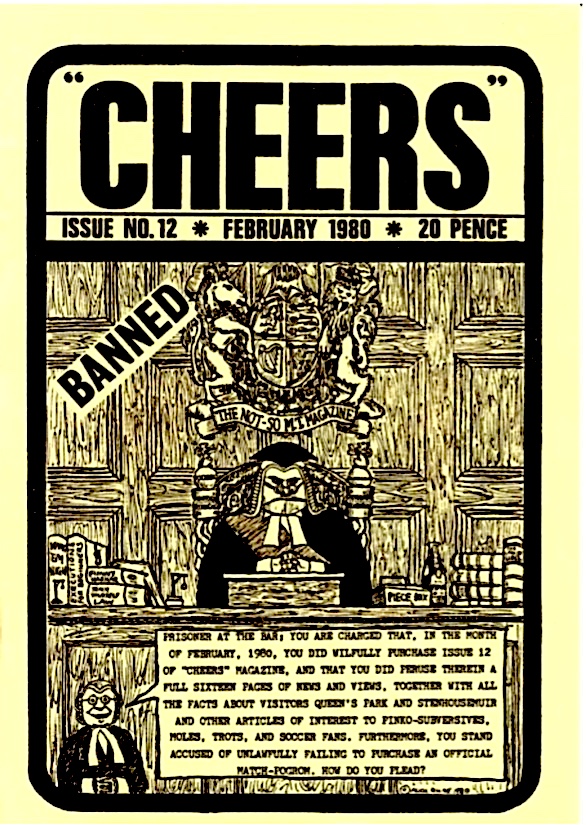
There were a very few individul club fanzines going in the late 70s and early 80s but even then there was protest. This cover from a 1980 Meadowbank Thistle fanzine called Cheers tells what would become an all to familiar tale of a club banning a fanzine because they said it was affecting programme sales. ‘Prisoner at the bar, you are charged that, on the month of February, 1980, you did wilfully purchase issue 12 of “Cheers” magazine and that you did peruse therein a full sixteen pages of news and views…You stand accused of unlawfully failing to purchase an official match-program’ Edited by a disgruntled former club programme editor, Alastair Petrie-Hay, Cheers only started calling itself a fanzine after issue 12 and was apparently actually selling MORE copies than the official programme.[1]

In the face of alternative voices clubs and the authorities pushed back and this story would be repeated up and down the land during the period of peak fanzine popularity, many clubs panicked and banned fanzines from being sold inside grounds.
In fact, the problem became so widespread that on the 5th February 1990 EDM (Early Day Motion) 441 was tabled in the commons. The text reads “That this House believes that the growth of football fanzines is generally a healthy development which reflects the desire of more and more soccer fans to have a say in the running of their football clubs and to comment more widely on their game; and therefore calls upon football clubs and the police to make arrangements for these fanzines to be sold at matches in the same way as club programmes are and without causing any obstruction.”
Sponsored by 12 Labour MPs (and no conservatives, SHOCK!) including Mike Watson, who was the co-creator of Dundee FC Fanzine E Mind O’Gillie. Being an EDM and with the Tories firmly in power of course this went nowhere but it does act as a potent historical reminder of how important the fanzine movement had become.
Stand By Me.
Fanzines boomed during a period when a truly awful sequence of events changed football and fandom in the UK forever, the Bradford fire, Heysel disaster and Hillsborough tragedy claimed the lives of 56, 39 and 97 fans respectively all in the space of 4 years (1985-1989). These events and the reaction to these made protest an intrinsic part of the culture of football supporters as fanzine numbers grew exponentially. In 1986 When Saturday Comes listed 5 fanzines available, by 1990 there were over 200 available.
Jim Cook, creator of the Notts County fanzine The Pie stated perfectly what fans faced and why so many fanzines were protesting; “Margaret Thatcher was in power and after battling the miners she set her sights on other social groups, including football fans. There had been a backdrop of hooliganism back then and English teams had been banned from Europe after the Heysel Stadium disaster. She decided we were all the same and wanted all football fans to have to carry ID cards. Most of the media toed that line as well, and football fans were getting bad press all over the place. However, most of them we knew were decent people who just wanted to go and watch their local team.” [2]

Fanzines mocked Thatcher, her minion Colin Moynihan and his proposals for ID cards, covers and cartoons[3] appeared everywhere, Issue 4 of the popular Coventry fanzine “The Westender” for example,

and further down the leagues in Chesterfield, the same theme was explored on the cover of and early edition of the revered Crooked Spireite fanzine. There were thousands more up and down the land.

There were more bows to the government’s string than The Football Supporters bill and ID cards. Controls and bans on fans travelling and a tacit encouragement of police violence were ever present, and all of these actions were cheered on by a willing press, The Times newspaper even ran an editorial calling football a ‘slum sport played in slum stadiums and increasingly watched by slum people’. [4] Shocking but completely in character.

One of the earliest general fanzines, Off The Ball (OTB) Fanzine was at the forefront of protest, its co-creator Steve Beauchampe would go on to create the FSA, still very much alive as we have seen. In an article from August 1987 called “Forgotten Fans” OTB highlighted the terrible treatment that disabled fans received.

The article goes on to point out that Wembley, the national stadium, was worse than most grounds before an early complaint about ticketing policies further marginalising fans.
Some Might Say.
Fanzines weren’t just ignoring some shocking problems on the terraces though and several fanzines promoting lesbian and gay rights arrived with The Football Pink a prime example. This great photo by Richard Davis appeared in the recent Voice of the Fans exhibition showing its creator Dave Ansell, he brought Pink out as a counterweight to the tabloid’s exploitation of Justin Fashanu’s biography “Coming Out”. Several immaculate copies of this important fanzine are available to view in the National Library of Scotland.

Thankfully it’s now hard to imagine a time when setting up a gay football team would be considered noteworthy but Issue 4 of the Football Pink reports “As of March, Britain finally got. gay football team for the first tim in more than a decade” The editororial in this issue aalso notes that “many fanzines are being a bit more careful about what they say recently, and that one has even apologized for making the odd homophobic comment in the past”. Sadly 2024 once again saw an increase in homophobic chants at some grounds. When will we learn?

This letter appeared in When Saturday Comes and highlighted how fanzines were trying to change the outlook of their own readership, terrace behaviour and highlighting the failings of some fanzines going too far as well. An important message about cleaning our own house as external forces tried to tar all football fans with the same brush.

Finally let’s return to Off the Ball and a protest piece against the cattle pens and fences used in grounds at the time. March 1988 saw an article called “Monstrous Erections” published. In it they criticised the Popplewell report on Heyshel for ignoring what was in plain sight to so many fans. The horrific fences and pens erected by clubs to keep fans under control were an accident waiting to happen. A year later at Hillsborough this was seen to be horrifically prescient.

Don’t Go Away.
So where are we today? There have been many improvements in facilities and some really great diversity and equality initiatives. Fanzine influence persists, the FSA recently contacted the Business and Trade Committee concerning the issue of dynamic (surge) pricing. In the UK the this has already caused widespread anger with Ticketmaster’s use of the practice for the 2025 Oasis concerts and though it hasn’t arrived British football, surge pricing has been introduced in La Liga in Spain[5] and, at the Club World Cup. [6]
Unfortunately, this also a stark reminder that nothing much changes with respect to attitudes to fans, the exploitation of supporter loyalty and that we still desperately need campaigns like Kick It Out and the rainbow laces initiative in football. The incident at Anfield last weekend should also act as a jolt to supporter bodies that there are still too many people out there that should be called out, reported and banned forever from stadiums up and down the land.
It’s time for football fans to rise again. It’s never really not been time..perhaps we need more print fanzines running to galvanise us… Later blogs will look at the more local issues that fanzines addressed and protested about and the fight against racism.
[1] https://www.independent.co.uk/sport/q-a-the-perils-of-away-successes-1420488.html
[2] https://leftlion.co.uk/features/2024/05/interview-with-jim-cooke-of-1980s-2000s-notts-county-football-fanzine-the-pie-selectadisc/
[3] Courtesy of this excellent blog https://cadhain.wordpress.com/2020/07/10/the-westender-a-football-fanzine/
[4] https://www.theguardian.com/commentisfree/2016/apr/29/hillsborough-lie-victims-wrong-class#:~:text=Hillsborough%20lie%20endure?-,The%20victims%20were%20the%20wrong%20class,596
[5] https://www.forbes.com/sites/henryflynn/2024/09/03/as-valencia-adopts-dynamic-pricing-live-soccer-becomes-an-even-more-exclusive-club/
[6] https://www.nytimes.com/athletic/6001263/2024/12/17/dynamic-pricing-club-world-cup-tickets/

 Football Fanzine Culture
Leave a comment