
When people ask me what my favourite fanzine is it’s impossible to answer, there are just so many to choose from BUT I always recommend people look at lower league fanzines in general because they were often the best in terms of creativity and storytelling. So, whilst spending many happy hours trawling through old football fanzines preparing for a talk at Leeds central library my thoughts focussed once again on what a remarkable source of social history fanzines are. We’ve told the story of some of the protest initiatives driven by fanzines here https://footballfanzineculture.blog/2025/08/21/protest-and-protest-culture-in-fanzines/ so in this blog we’ll look at a more granular level at how fanzines remind us of the past and tell us stories of people who perhaps don’t get enough attention.. with a little bit of music thrown in for good measure.
The Blue Brazil
Let’s start with the Blue Brazil, Cowdenbeath, now a member of the Lowland league but in 1998 ploughing along in the heady heights of the Scottish Football League Second Division which was obviously the 3rd tier. Despite their lowly status Cowdenbeath had 3 absolutely superb fanzines over the years, today we’ll focus on “When the Sun Shines” (WTSS).

Unfortunately named after their own version of a Johannes Bouwens song made famous by Jonathan King it was nevertheless always a great read. The cover itself contains a great cartoon making a joke at the expense of the old firm but also as a reminder that there was real opposition to the Premier leagues that sprang up in England and Scotland at the start of the great land/money grab by teams at the top of English and Scottish football. The way these teams dominate financially today and the total lack of media attention on smaller teams is proof that the fears of people at the time were very much founded in fact.

There is this lovely little advert from the local estate agents that sponsored the fanzine. (Many thanks to them for doing that and a reminder that they are still going today for all your Fife based conveyancing needs)
It’s a lovely reminder of local companies before mega corps took over and the days before the internet when “Large Property Display Windows Throughout Fife” was a key to getting listings and selling your house relied on people walking down the high street and poking their nose in a window.
But our heroes at WTSS don’t stop there, in issue 12 (only £1 for all of this remember) There is what is on the face of it a very dull piece about the fact that chairman Gordon McDougall recently celebrated his 7th anniversary as Cowden chairman and that made him the 5th longest serving chairman at the time!!!
That’s not what’s important though, the next paragraph gives us a lovely potted history chairmen and their contributions to the town. I’d love to get salacious details of the boardroom dispute that caused Andrew Dick to leave but that’s for the library and another day, this is a great reminder that all clubs were once very much part of the community that surrounded them, something still prevalent lower down the leagues but very much not in the stratosphere of the premier leagues. If you wanted to make a protest in those days you might do it on the high street of your community, nowadays protesting against a corproate entity thousands of miles away is a rather different proposition.
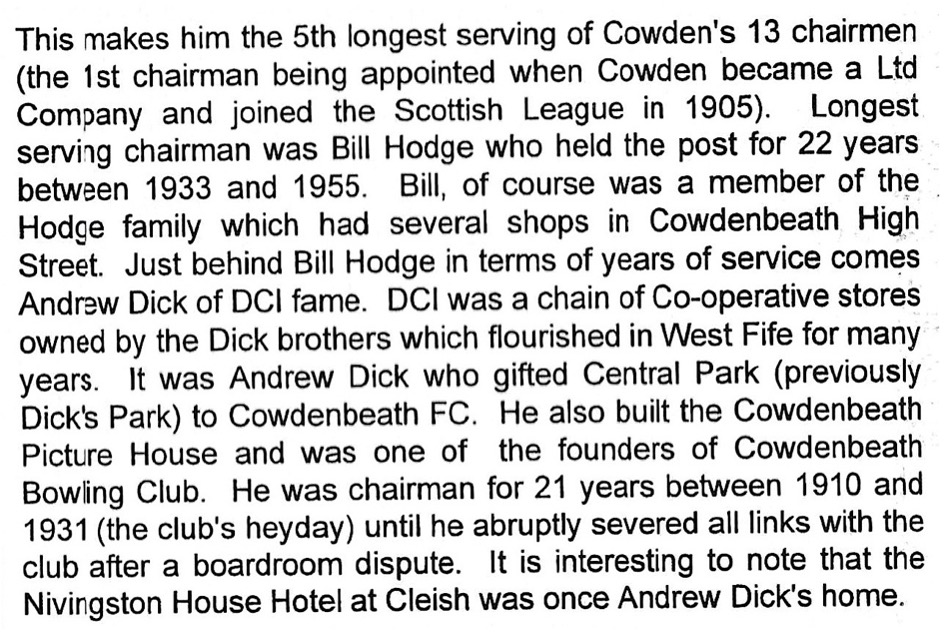
Three pieces of social history about business, local history and the importance of community all within the first 5 pages of a small but tremendous fanzine from Fife.
It’s A Banker (The – Ed)
Lets move now to Lincoln and to the pages of The Banker. Here we uncover the unlikely story of the beginnings of one of the most important record labels of the past few decades, the lure of London and the ever present issue of disappearing music venues.

Issue 3 was published in March 1989 and had a lurid green cover (WHY?) It also contained an interesting piece about music in the city and served as a reminder of how much times have changed since the late 80s re gigs and the provinces.
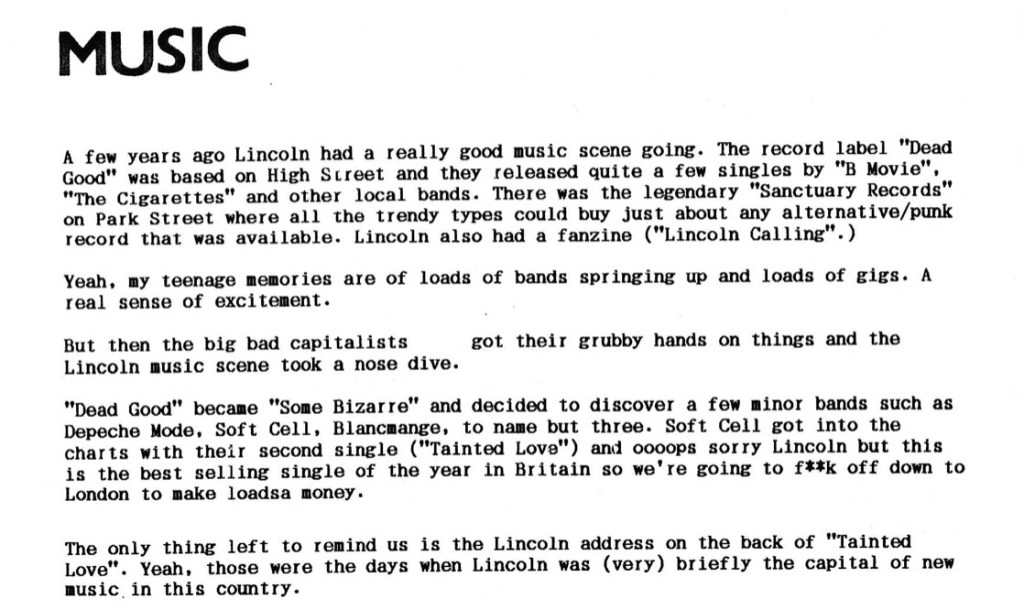
The author sarcastically bemoans a local Lincoln record label quickly upping sticks and moving to London. Dead Good were to become the brilliant label Some Bizzare who discovered Blancmange, Cabaret Voltaire and Depeche Mode! (he missed The The, B Movie, Fad Gadget and perhaps understandably, Neu Electrikk)

The piece mentions something about Lincoln appearing on the cover of the best-selling single of 1981 by another Dead Good discovery Soft Cell with their cover “Tainted Love”. Now I have two copies of the 12” version of this because of reasons and so I quickly went to check the veracity of this…and yep, there Lincoln is on the back of the sleeve.

Being a fanzine, they spell the word bizarre in Some Bizzare correctly but incorrectly, this could be forgiven as it was deliberately spelt wrong. Label boss Steve Pearce said “I like ambiguities. It’s Some Bizzare, spelt B I Z Z A R E. The idea of the label was to be aware of people’s expectations and do the opposite almost”
Pearce was known for his odd behaviour; the label offices included a private chapel and confession box for would-be-signings to go through a solemn process to hand-over demo tapes[1]. The label is now defunct, their website offline and Pearce’s whereabouts are unknown.
Back to the fanzine, the author wants to recreate a “decent” music scene in Lincoln and that the Banker would be playing their part in that, starting to list gigs including CARTER USM and the fact that the assembly rooms in Lincoln were now stocking the fanzine!

The bands listed here could easily describe Lincoln’s footballing progress over the intervening period, lots of ifs, buts and what might have beens mixed with oblivion. The entry prices to the gigs, between £1.50 and £3, are enough to make you weep. (Fyi; Gorillaz tickets go on sale tomorrow morning at a minimum of £100 a piece) Carter USM of course successfully continued for decades championed by another fanzine contributor, Mr Steve Lamacq but what about the others and the venue?
Success came for The Family Cat who released 3 albums, were single of the week at NME and recorded 3 Peel sessions.
4,000,000 Telephones had modest success in the 80s and toured extensively in the UK and Germany. In February 2023 they released an album of previously unreleased material from the time. Yeah, I missed that as well. The NME once said they were “Tipped as hot property on the indie scene… there is something excitingly different hidden beneath…” It remained largely hidden.
The Raindogs are still pootling around various festivals in the Midlands, but I can’t find anything about Quadro. The Assembly Rooms are still there but only for “corporate events, meetings and wedding receptions” nowadays. A perfect example of the fate of many provincial music venues and another great example of social history writ large in fanzines.
Vinyl Whistle
Fanzines were treated as pulp fiction, something to read at half time and on the bus home but then to be forgotten and discarded. This was a huge mistake, for a start there was serious writing about protest and the documentation of the appalling treatment of a subset of people. In 1985 The Times carried an editorial saying that football fans were “Slum dwellers watching a slum sport” and the government and media of the day saw all football supporters as a subclass. That’s something I will never forgive nor forget.
Look closer and you will discover that also contained in the pages are not just jokes, banter and the rants of frustrated fans. Along with the protests that would change history, there is great writing about and pride in local history and community plus a record of how everyday life was. That is something worth curating and documenting properly and is something that I’m very grateful to be able to look back on today.
Sometimes you can only laugh at the absurdity of the way we lived but generally you end up marvelling at this incredibly rich coverage of what had and was happening to and in our towns and communities, with echoes still being heard today. I’ve only used two small fanzines for the multiple examples in this short blog, there are tens of thousands more stories like this and we’ll come back to them from time to time.
[1] Malins 1999, p. 20.

 Football Fanzine Culture
Leave a comment