
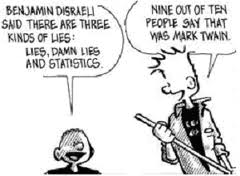
“There are three kinds of lies: lies, damned lies, and statistics” is a commonly stated phrase supposedly invented by Mark Twain, but it was actually created by Benjamin Disraeli…statistics being used incorrectly, oh the irony.
I suppose we shouldn’t complain, you should see some of the stuff that was in fanzines as well.. oh, hold on, that’s why I’m here isn’t it?
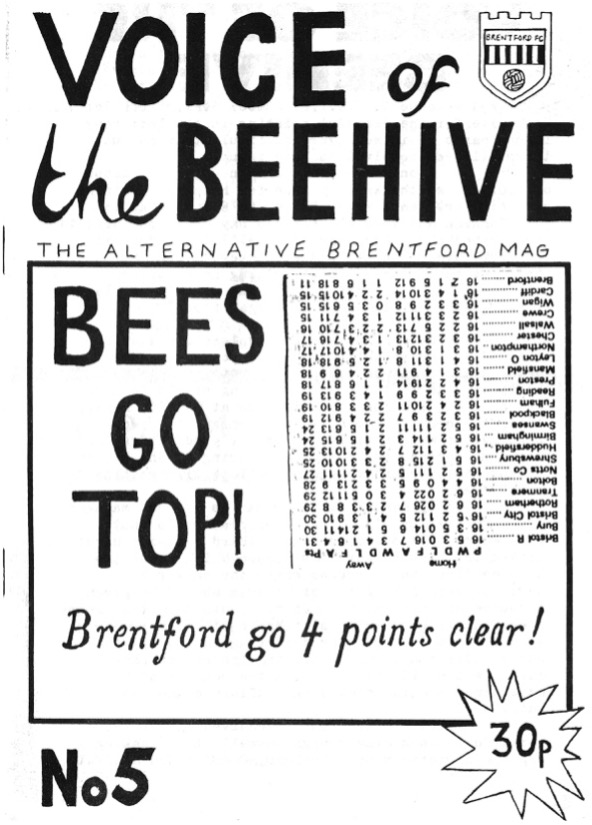
Let’s start with an obvious but amusing lie. This was the cover to Brentford fanzine Voice of the Beehive issue 5 in 1989. Of course it’s silly, stupid even, what did you expect for 30p? Well I ran a large engineering group for a while and let me tell you, I’ve seen less sophisticated ruses than this used before.
How about this that appeared in When the Sun Shines, a Cowdenbeath fanzine in 1990. It’s a list of goals scored vs goals conceded by each team in Scotland since the reconstruction of the leagues.

It doesn’t actually say WHICH reconstruction, a bit of an issue to start with. It seems obvious that it was the 1975 schism which reduced the top league from 18 to 10 so they could call it “Premier” but that’s not the only issue…there is no context. What does it MEAN that Cowdenbeath were top of goals for and bottom of the goals conceded leagues. Did a goal difference of -31 over the years mean they were more likely to draw? What about promotion and relegation, had the like of Hearts been on a goal scoring spree since they were relegated to the first division…did the interminable 44 match season that was the SPL by 1986 play a part, Morton conceded 100 goals in one season in the PL, does this table include cup goals….anyway, you get my point.
Better than all this though is the small print at the bottom…when these stats were put in the fanzine, they were already 2 years out of date! Classic fanzine stuff.
There are many more astounding examples like this but that is for an exciting upcoming blog all about stats in blogs (do I not entertain you?). This week though, because my first stats blog is the 2nd most read one on my blog site (https://footballfanzineculture.blog/2025/06/19/the-list-statto-edition/ ) I decided to create some more meaningless stats of my own and in the style of statistics “collect, organize, analyse and interpret, presenting data to understand a population or phenomenon” which fanzines certainly were.
The List, an update.
The following “stats” are gleaned from over 1000 of the fanzines on the list of 1742 we have created and/or 1150 that I have analysed in my own collection, so a reasonably representative number.
We’ve now found 1742 distinct football fanzines. When I last wrote about this in June, we had 1706 fanzines so we’ve found quite a few more since then though the rate is tailing off a bit now. We’ve now seen proof of fanzines for
- 958 English football leagues (Top 4 divisions)
- 309 non-league teams
- 188 Scottish football leagues (Top 3)
- 183 “general” fanzines
- 38 Scottish junior leagues
- 55 in Ireland
- 32 in Wales (Excluding EFL teams)
- 45 for international teams
- 3 for Sunday League teams
- 1 Junior football team
I had a note here to put in some fanzine oddities here but really things like joint club fanzines were more frequent than people think, off the top of my head I can name 11 including ‘Where the Seagulls Dare’, a joint Colwyn Bay/Manchester City fanzine and the incomparable UTD United, a joint West Ham/Dundee United fanzine.

This was created by two editors whose single club fanzines weren’t doing so well so they decided to join forces. So far so good but 400+ miles apart? Even more extraordinary but prior to publishing a few editions the two editors HADN’T MET!! All planning, correspondence etc were done via telephone or mail (One for the teenagers there) It didn’t last long.
Chart toppers
Some charts are always nice, aren’t they? We cover 1980 to 2024 in this section for scale reasons and pre 1980 there wasn’t much happening. Let’s now look at fanzine growth. Everyone knows that fanzines reached their peak in the early 90s but what drove that? Can we pinpoint a year when it reached a peak..
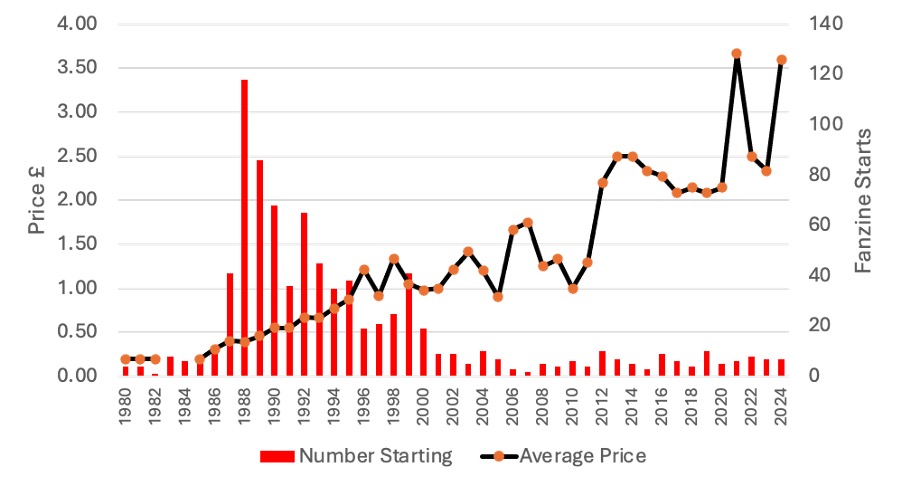
Surprisingly, with all the fanzines we’ve looked at the peak for fanzine starts so far is 1988. I had assumed for a long time that fanzine starts peaked in 1989 or 1990 in response to Hillsborough but in fact, with 118 starts that we’ve traced so far, 1988 was the peak. I should caveat this by saying we still have about 700 start dates to trace but right now it looks like fans’ protests at the government and press’ response to Heysel and Bradford, the proposals to introduce ID cards and more fences were important drivers.
The average price for a fanzine over 44 years has been 96p or 2.8 pence per page (ppp) however, remember this is heavily weighted by the 1980s and 90s when most fanzines were printed. The average price of a fanzine since 2010 has been £2.26, before 2010 it was 84 pence and in 2010 the average fanzine price was only £1.75 (2.9ppp) and it has doubled since then to £3.5 in 2024 (9.2ppp).

I’m not sure what this says about the Bank of England inflation calculator but remember inflation is not a linear function and calculators act like it is. Remember also that a lot of fanzines in the 80s/90s ran at a loss and folded because the labour of love became too onerous. To give some more context, since 1990 premier league ticket prices have risen by 800% since 1990[1] at some clubs and before someone points out that the average fanzine price has gone up by 600% + remember that much of that has come in the past 5 years as the economy has tanked because of Brexit etc and more importantly fanzines haven’t had a massive injection of sponsorship, TV and prize money either.
To give even more context, “old timers” fanzines like Fly Me To The Moon, The City Gent and Pandemonium are STILL only £2 a piece, well done guys. Let’s be honest, even at 3 or 4 quid a fanzine is still a bargain. By the way, the most obscure price we’ve found for a fanzine is 17p for issue 20 of Cheers, the Meadowbank Thistle fanzine/programme in 1981 (another story for another day)
Never mind the quality, feel the width
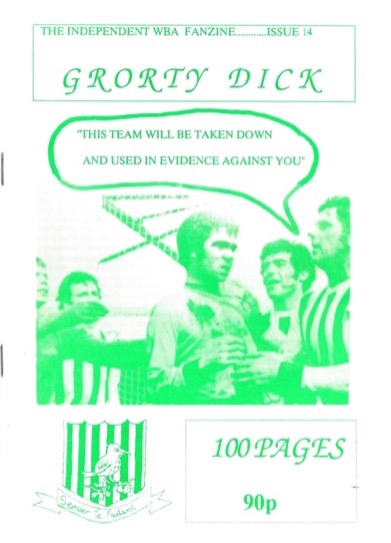
The average length of fanzines has been 34 pages with a quick early shift moving from 16 to about 40 pages by 1996 and staying there since. I should add that there have been occasions when fanzines ballooned much higher than that, first with the 1991 issue 14 of West Brom fanzine Grorty Dick and then in 1994 issue 50 of The City Gent both reaching 100 pages! Talking of record output, in the month of March 2005 The Oatcake produced 5 issues, all 24 pages long, all a bargain at £1.20 a copy…

In it for the money?
An extraordinary letter and reply appeared in Gulls Ear, a Brighton fanzine that started in 1990 as they were struggling to stay in division 2 (Championship) We’ll return to these lads later in a blog about legal issues, for now I suspect the letter might have been fake (no one signs a letter Vehement Bullshitter!!) but the answer re the economics of a fanzine is interesting.
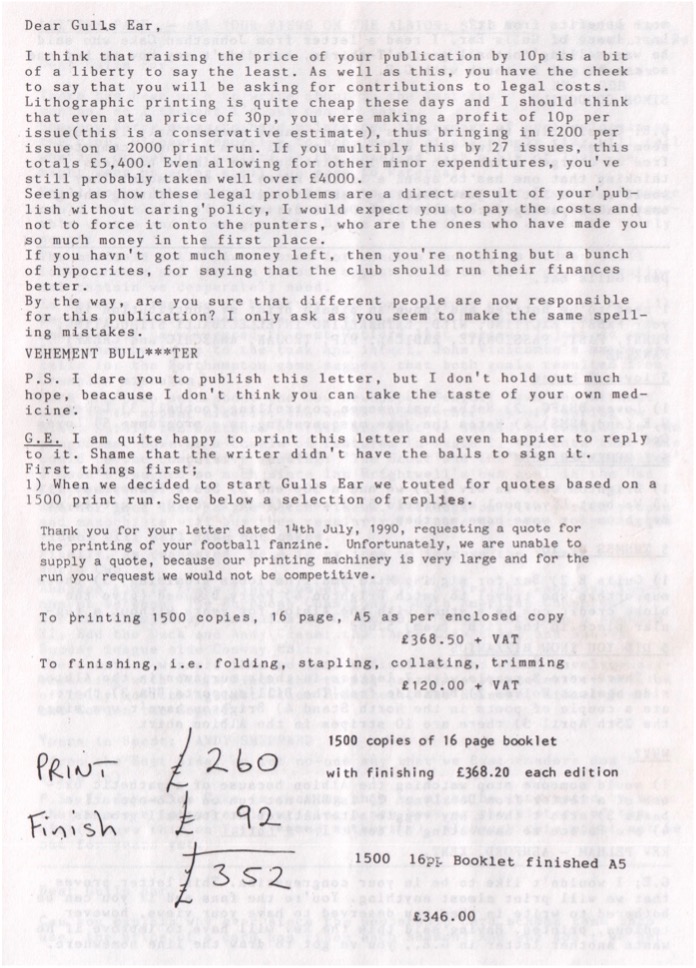
Mr Bullshitter’s complaint is that the fanzine price has increased from 30 to 40 pence…in reply the fanzine explains that firstly, some printers wouldn’t even take the work on! They explain a 10p price rise is needed as at 30p that would only just cover printing costs never mind some money for sellers. Even at 40p they make just £130 and this was going to a legal fund (there was a £6,000 court bill to clear)
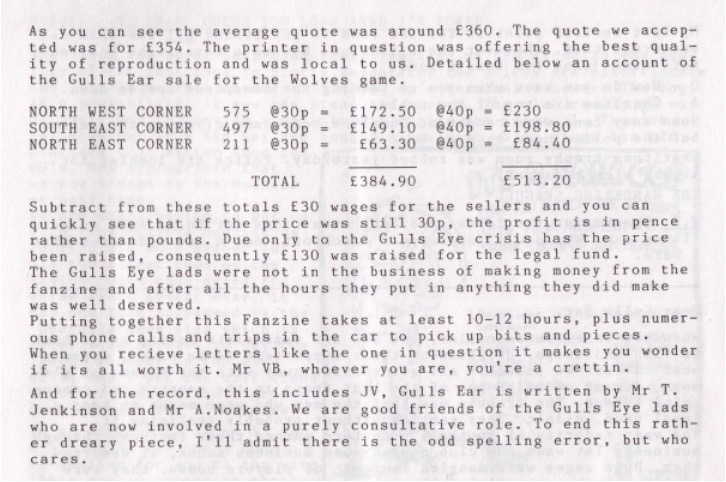
Then comes the revelation that they are selling 1,283 issues at a game, some going at a relatively small club. Of course sales could vary a lot, getting sellers to each corner of the ground for example and let’s say the weather was bad, that could easily knock a couple hundred off sales. The break even at 40p would be 880 copies, and the fanzine points out, was a £130 profit enough to offset the effort going in even if it was only 16 pages. With the size of print used sometimes this could still be a lot of content plus 10-12 hour of work, labour costs, phone calls, car journeys etc
Final Whistle
Everything needs context; What does this really mean? Why is it being said in this way and why now? Who are the people saying these things and what world were they inhabiting? This is especially true of fanzines.
Statistics are often treated as just numbers on a page, Cowdenbeath might have scored most goals of all first division sides but so what? People think that pure numbers tell the story but that’s not true, you need to take what I believe consultants now call “A 360 degree holistic view”. In simple terms, context.
There really are lies, damned lies and statistics but you can always look beyond for the truth.
[1] https://www.theguardian.com/football/2025/jan/06/prices-have-risen-800-since-1992-the-premier-league-fans-unions-campaigning-for-affordable-tickets

 Football Fanzine Culture
Leave a comment