

If there are any members of the Office for National Statistics watching I apologise for what is to come, although based on the criticism politicians have been doling out, maybe you can pick up some tips here lads.
In 2020 the ONS proudly announced a strategy called ‘Statistics for the public good’ but way before that fanzines were taking this to the extreme. Fanzines used stats to fill space, to prove a point, to highlight a problem, whatever it might be they had stats. Unfortunately, the methodology sometimes left a little bit to be desired or proved a point that really didn’t need making. Anyway, come inside as we play statistics roulette.
Ye Olden Days
Proving that you don’t need fancy stat packages anyway, Chesterfield’s always brilliant Crooked Spireite often carried tables of previous season’s results. In this case issue 8 from 1988 carries the entire 1898-9 season stats of Chesterfield Town including teams’ lineups…all handwritten. This is NOT a spoof!
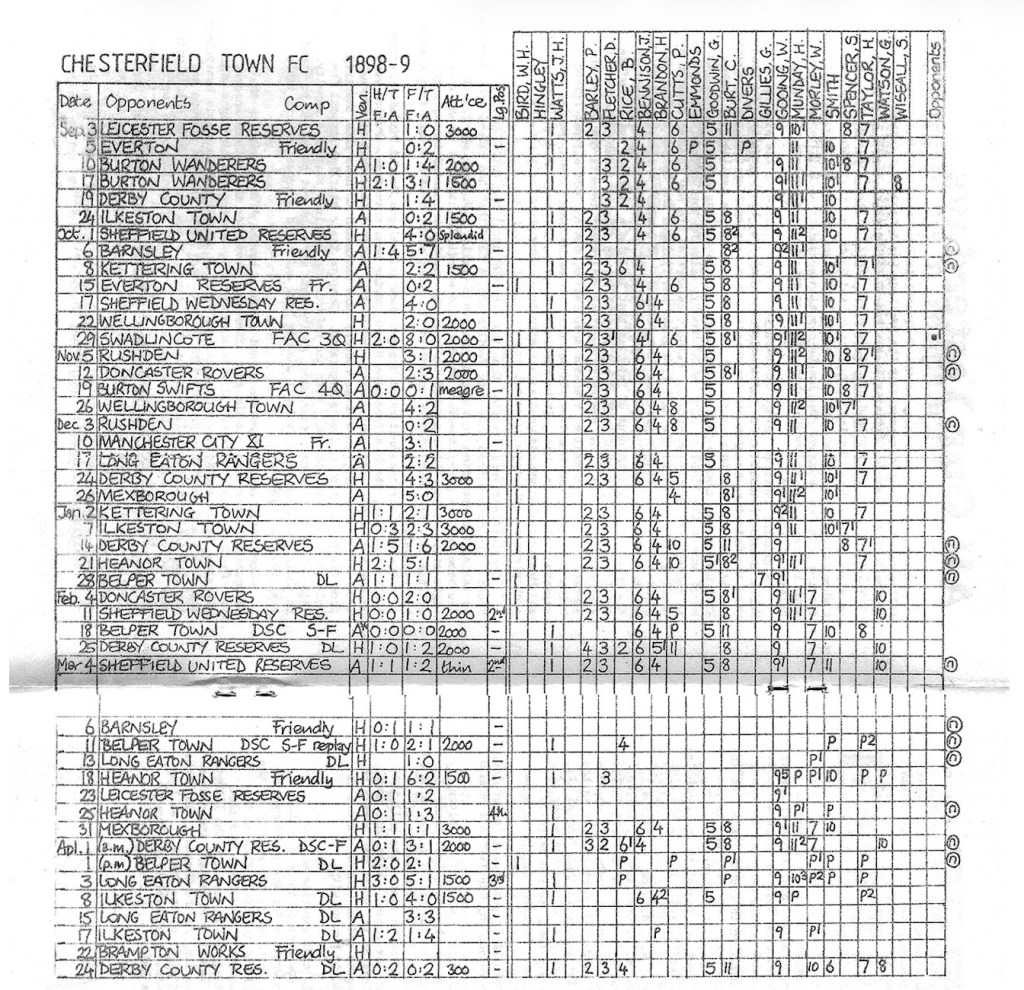
Attendances reported as “splendid”, “meagre” or “thin” are here as are 5-7 defeats in friendlies vs Barnsley and a 6-2 win against Heanor in front of 1500.
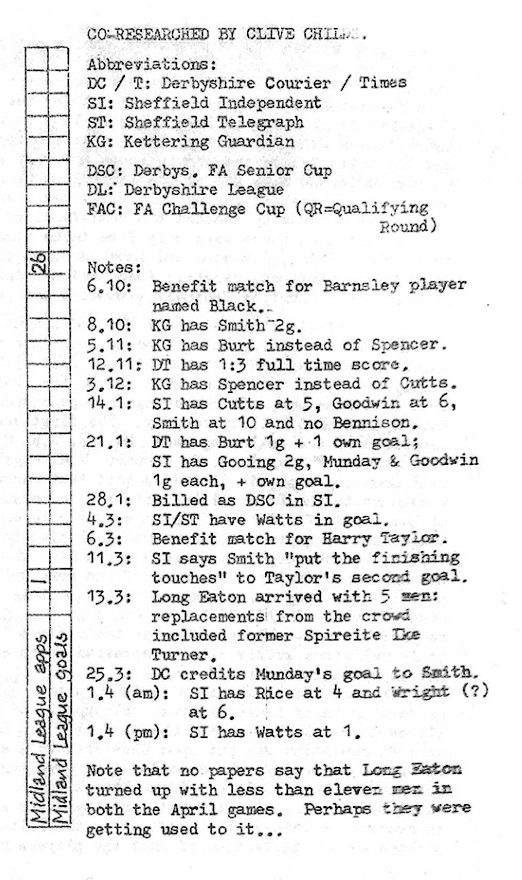
Plus there are notes. Oh my word the notes, what a thing of beauty those are, we find that the Kettering Guardian mistook Cutts for Spence and that Long Eaton were prone to turning up with less than 11 men. Who needs excel, who needs AI?!
The lives we might have lived
Great stats come in all shapes and sizes, Colchester’s Floodlight issue 6 in1989 decided to do a ‘Shortest Appearances XI’ (and why not as Barry Norman would say).
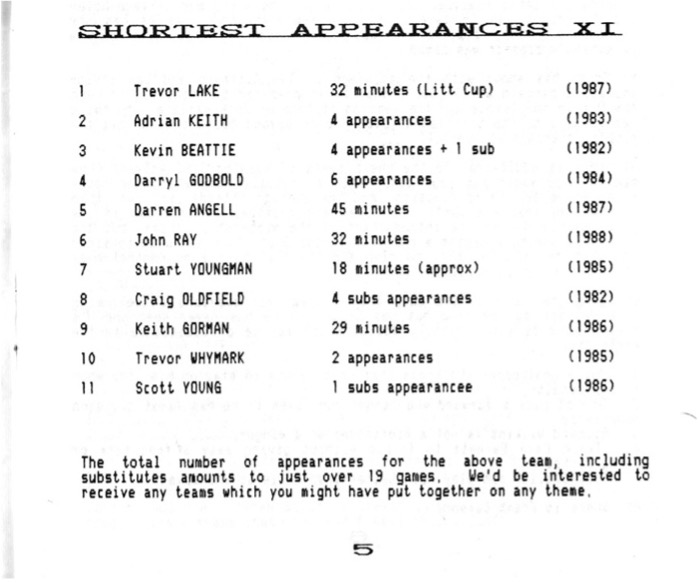
Kevin Beattie and Trevor Whymark appear, former England internationals “transitioning” as they did with the local lower league clubs. Then there are enigmas like Keith Gorman, prolific in his youth career, 59 goals in 41 appearances for Ipswich but then only managed managed 1 appearance for 3 clubs in East Anglia before returning to his native northeast and the Northern League. There is surely a back story there.
Saddest of all though is poor old Trevor Lake, a standout having not even completed one game in 1987. I looked him up and it seems that 32 mins into his debut Lake suffered a serious knee injury whilst taking a goal kick and was never to play again..Life is cruel, and fanzines record it, perhaps inadvertently but still.
Back to Reality
Port Vale ‘s Vale Park Beano decided that not only were referees incompetent but to take their spin on this one notch above all (and I mean, ALL) other fanzines they added a numerical ranking. Not sure they ever explained all the ins and outs of ‘The League of Incompetence’ but to make it even better they added colourful one word descriptions to all referee performances and reversed the scale…
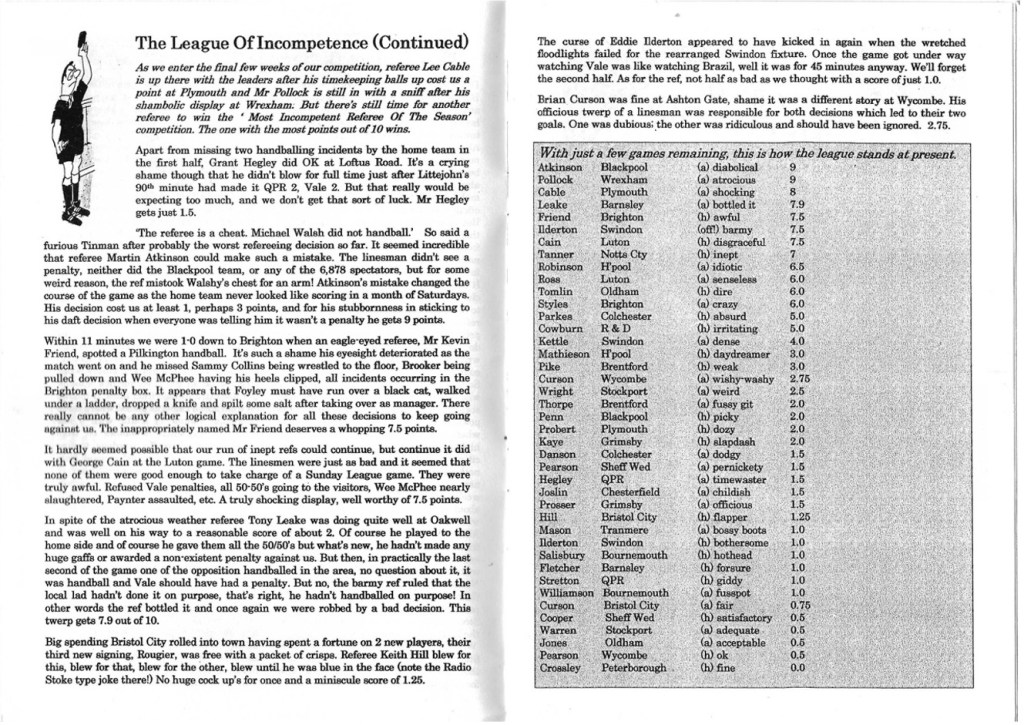
This ran for many issues with the one here from issue 39 in 2004 being par for the course, much effort, no real data. Confused? Well, a “fine” display got 0 points, a “Childish” one was awarded 1.5, “absurd” received 5 (does that mean absurd is average? – Ed) and diabolical gets 9.. Flapper, daydreamer and bottled it are all in the mix and the page describing referees’ performances must have left the author in heart attack territory.
DIY
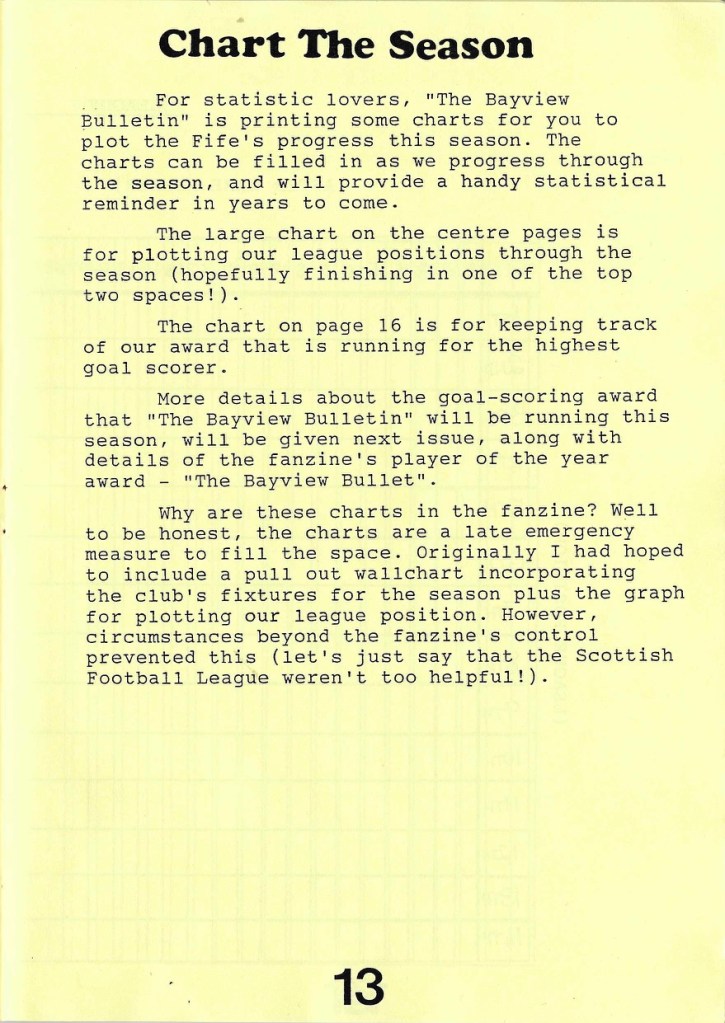
East Fife’s Bayview Bulletin issue 1 blame the SFA for them just being lazy and wanting to fill space in sensational fashion. The more astute amongst you will already be thinking just draw a straight line at 12 for the league position chart what with this being East Fife. If you want to “complete” the league position chart they finished a respectable 9th
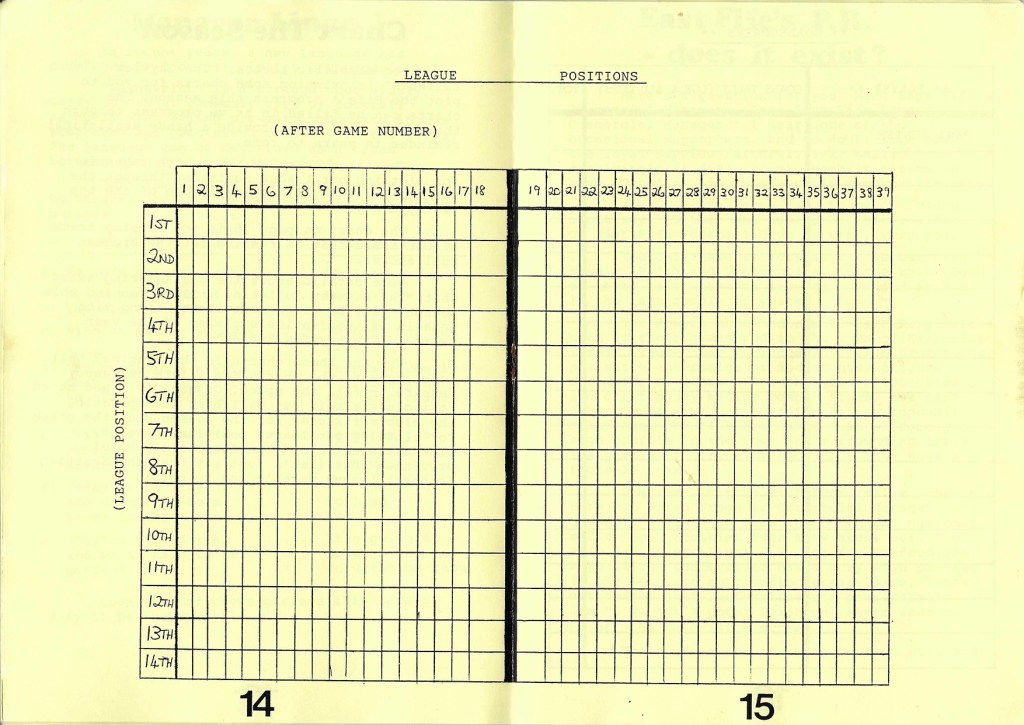
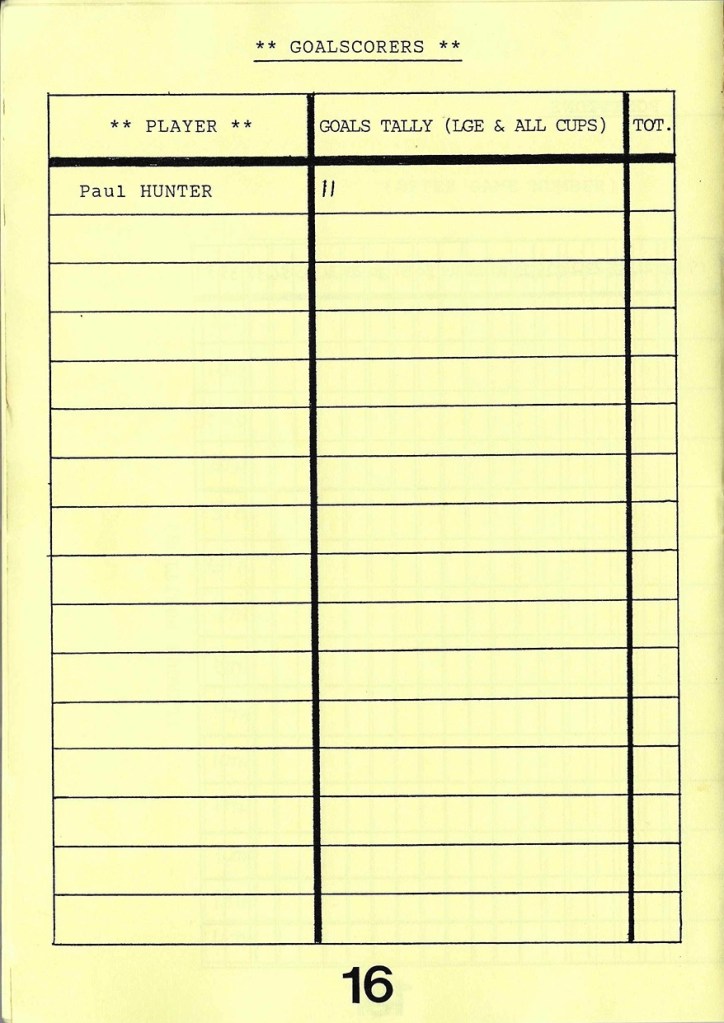
Paul Hunter did in fact remain top scorer but 11 when this issue went out in August 1989 seems to be a bit much, maybe it’s 2 as they had scored 6 in a preseason friendly at Barrow. (DAMMIT WHY WASN’T IT 5! WHO SCORED THE OTHER 4? – Ed)
The Bayview Bulletin became Away From The Numbers after 5 issues, quite..
Rabbit Holes
In another spectacular piece of space filling, Cambridge United’s The Abbey Rabbit issue 2 from 1988 went goalie crazy with this superb stat. Not sure if anyone ever did or indeed wanted to claim the prize.
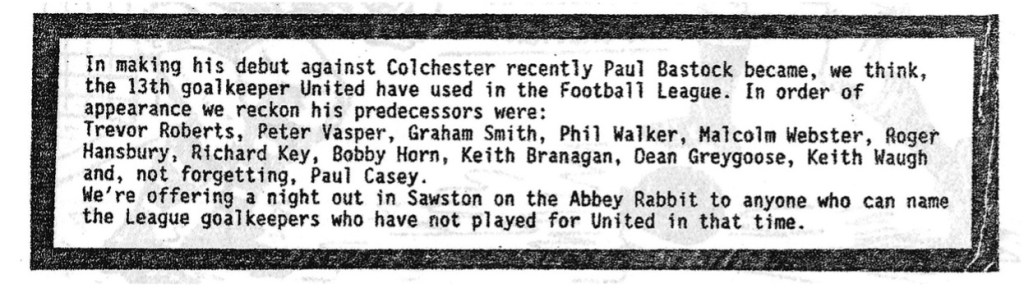
What is so superb about this innocuous little piece is that in 1988 there would have been no easy way to check this, it’s the sort of pub fact you could state safe in the knowledge that no one was going to challenge you.
Even better is the fact that this little mundanity lead me down this abbey rabbit hole; Bastock was a member of the 1987 Southampton FA Youth Cup winning side (including Shearer and Le Tissier) and went on to play for more than 20 clubs in the lower leagues (including Sabah FA, Pinchbeck United and Deeping Rangers, high octane stuff is this). He played 679 times for Boston and was voted Boston’s ‘all-time cult hero’ by viewers of Football Focus in April 2005…there is more if you want.[1]
Even better, held the record for the most competitive club appearances in world football, more than 1,286 times in league and cup competitions, across the English lower leagues, a record since surpassed only by Fábio Deivson Lopes Maciel.[2]
So, a daft little paragraph written 38 years ago has caused me to chuckle and then waste 15 minutes of my life down a Paul Bastock rabbit hole. Well done ladies and gentlemen of the Abbey Rabbit.
Listing Badly
OK, the Rangers Historian set out in its name what its intentions were but they weren’t just about text pieces on the history of Rangers vs Tottenham fixtures (really, volume 5 number 5, August 1989 if you want a look). They were also partial to a well laid out list of all the times Rangers had played in the Scottish Cup Semi Final including year, opponent, venue, result AND attendance. As a bonus they add that at this point only four Rangers players had scored hat-tricks in those semi-finals.
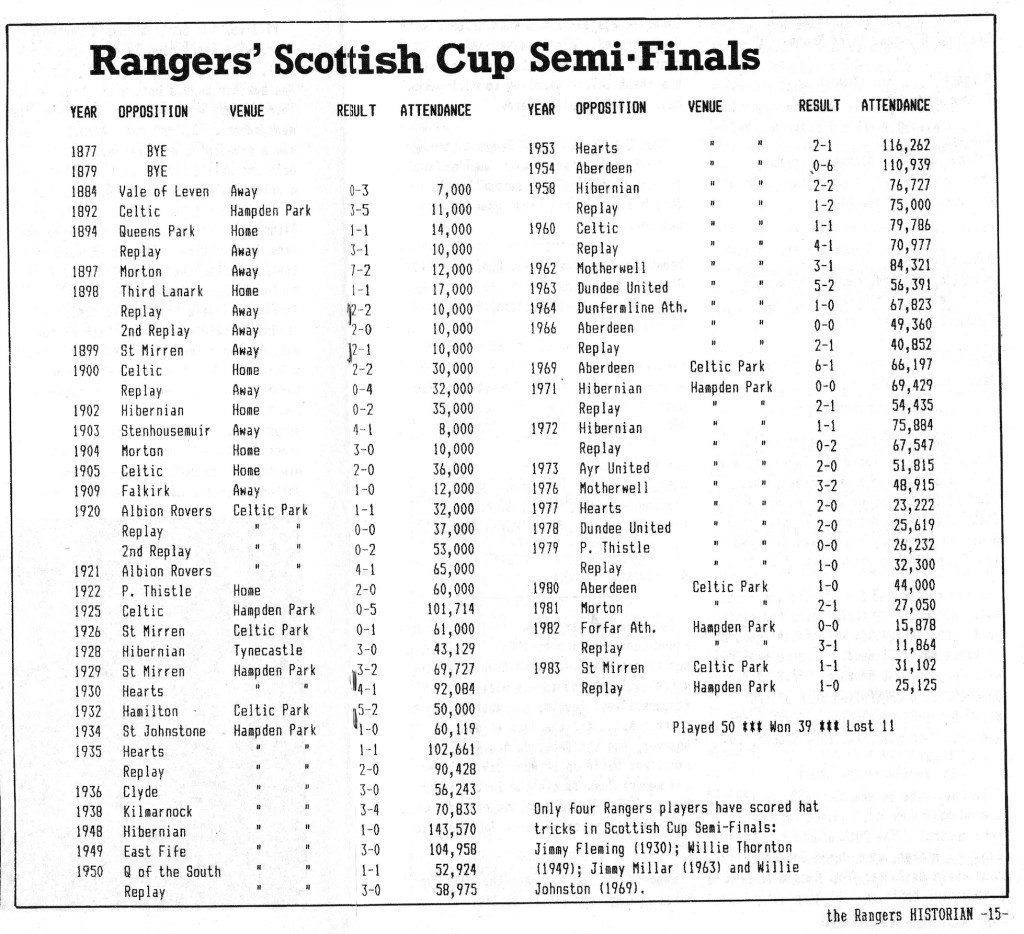
I asked fanzine doyen Simon Wright why on earth you would create such a list and his reply “because you never know when you might need it” was reassuringly sensible and logical in fanzine terms, here we are today.
Where are we now?
Today we have Xg or xG or Xa or however it’s supposed to appear, I’m not looking it up. I mean look at this nonsense from the Scotland Denmark match..Bloody hell!

It’s built from an algorithm that looks at “determining the likelihood of a shot being scored based on various factors, taken from the moment before the player shoots. These factors may vary depending on the statistical model, but include the distance to the goal, angle, shot type, and other contextual factors. Each shot is then given a probabilistic value, representing how many times that shot is likely to be scored based on similar shots” so complete bollocks then, it doesn’t consider the differences in players, the weather, pitch, whether the shot was taken under pressure, exceptional individual performances or goalkeeper heroics ….I could go on but Christ, it’s dreadful nonsense.
Statisticians and fanzines nowadays have access to all sorts of high-powered software packages. Take this example from the superb Manchester City fanzine King of the Kippax in 2020.
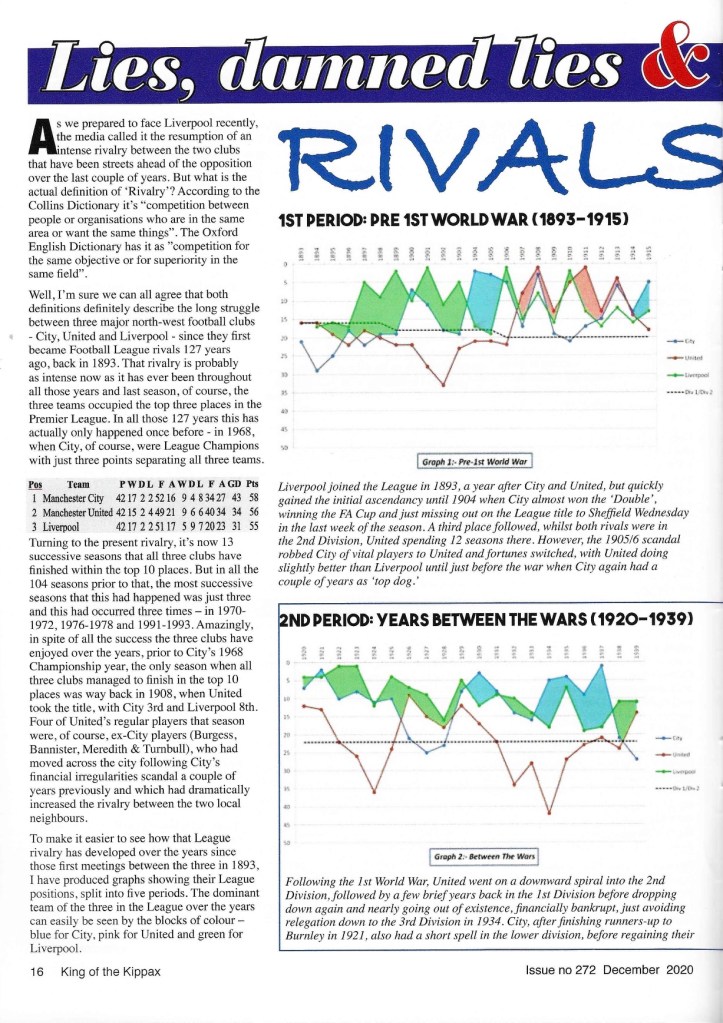
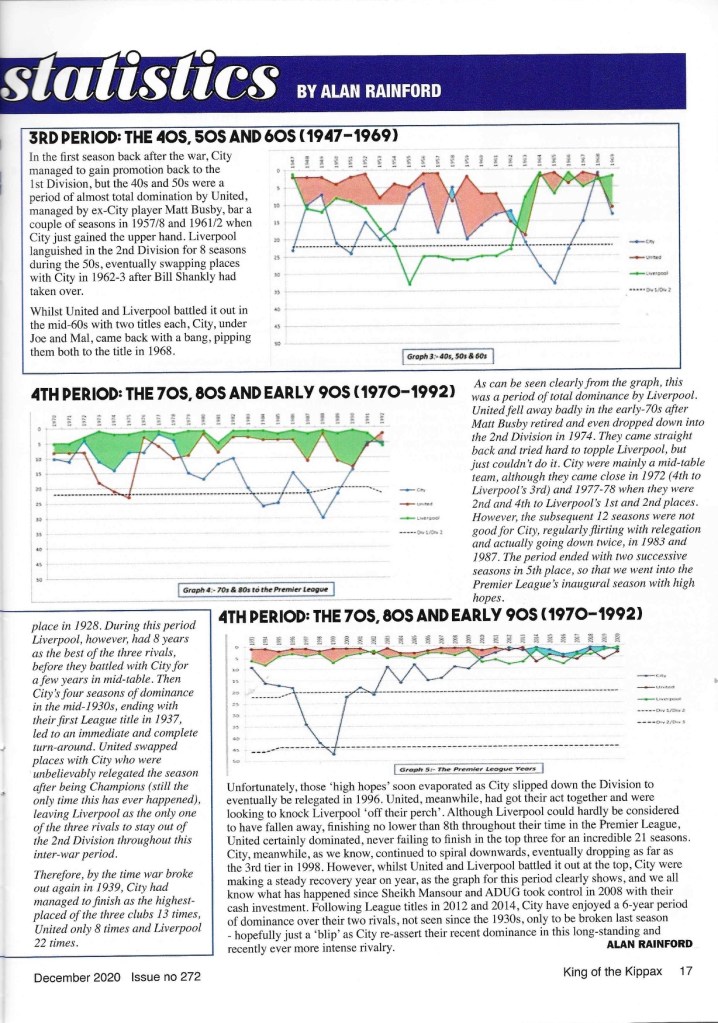
It uses visual data to look at the rivalry between City, United and Liverpool. It is magnificent to look at but does it really show anything? Not sure rivalry can be put in to numbers and charts but once again you have to marvel at the lengths fanzine contributors will still go to try to “prove” a point.
Forgive me but snappy, short, almost certainly misleading is what we need!
Final Data Drop
This is another topic that just keeps on giving, in a later edition I’ll cover a Scottish “Crime” league, a splendidly bitter analysis of relegation seasons for local rivals and a hand drawn chart with admission prices (sort of) adjusted for inflation.
I need to explain that you’re talking to a man who was once accused by someone in R&D of having used 2 data points to draw a line and prove a dubious relationship (This was a lie, there were 3 points). Done well statistics “provide context, relevance and connection to make a point compelling”…hmm
I also want to clarify I’m not poking fun at the use of stats and “data” in fanzines, quite the opposite in fact. The way ‘facts’, ‘data’ and ‘statistics’ were used is another example of the wonderful creativity, dedication and hard work that was always on display in fanzines and a great example of the sly irreverent humour that also proliferated. It’s brilliant stuff and in there are also lovely little snippets of the way we were and careers that soared or plummeted based on a whim of fate, something no data could ever capture.
This is also the first blog I have written with exactly 1503 words.
[1] https://en.wikipedia.org/wiki/Paul_Bastock
[2] https://en.wikipedia.org/wiki/F%C3%A1bio_(footballer,_born_1980)

 Football Fanzine Culture
Leave a comment