
I’m dedicating this blog to all the fantastic people at Leeds central library without whom none of this madness would have started and to Antony Ramm in particular who has been asking me to write a blog about fanzine poetry for a while.
My English master at school was very annoyed when I decided not to do English Literature at A level. I was going to but at the school I attended you could only do arts, humanities or science as groups and all may mates from the football team were off to do science, so that was me.
I was “good” at lit’ but derived more enjoyment out of writing down and pronouncing the names of poets backwards than reading the stuff. Deirfkeis Noosas was a particular favourite though Eibbor Snrub was also up there.
So there is no snobbery here, no attempt at ranking or criticism, just poetry that I’ve found in fanzines with a few diversions along the way about the back stories. There was a hell of a lot of poetry that ranges from the sublime to the ridiculous, from political to pure “art” from, from transfers to team selection, from protest to well, moaning.
In The Beginning
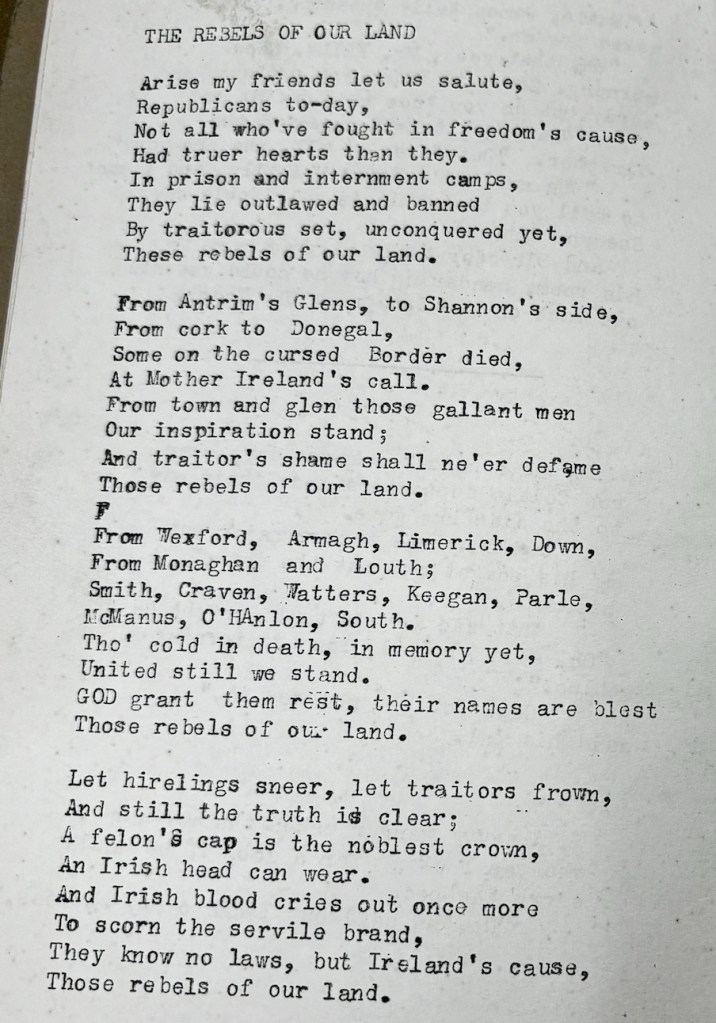
In fact right from the earliest fanzine we’ve found, Celtic’s Shamrock in 1962, poetry has been a staple to fill a page or two. In this case it was unsurprisingly a paen to the dead of the fight for an independent Ireland. Don’t worry, it gets lighter from here.
And as we reported recently, even today poetry persists (nice alliteration – Ed), St Johnstone fanzine Allez Les Bleus editor was very keen to include it from issue 1 and you can read an absolute belter about a legendary striker’s shorn hair here. https://footballfanzineculture.blog/2025/10/09/meet-the-editor-allez-les-blues-st-johnstone/
Liverpool based fanzine The End always carried poetry and not just pieces about haircuts but much broader issues, football away days, politics and protest, the dole and Bungle from Rainbow. Here are just two examples of hundreds, a poem about Top of the Pops and one about the establishment.
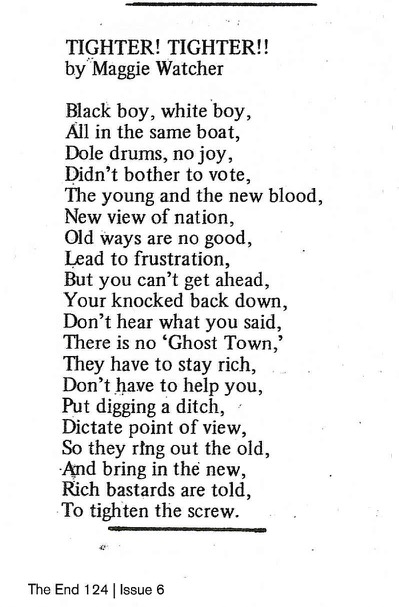
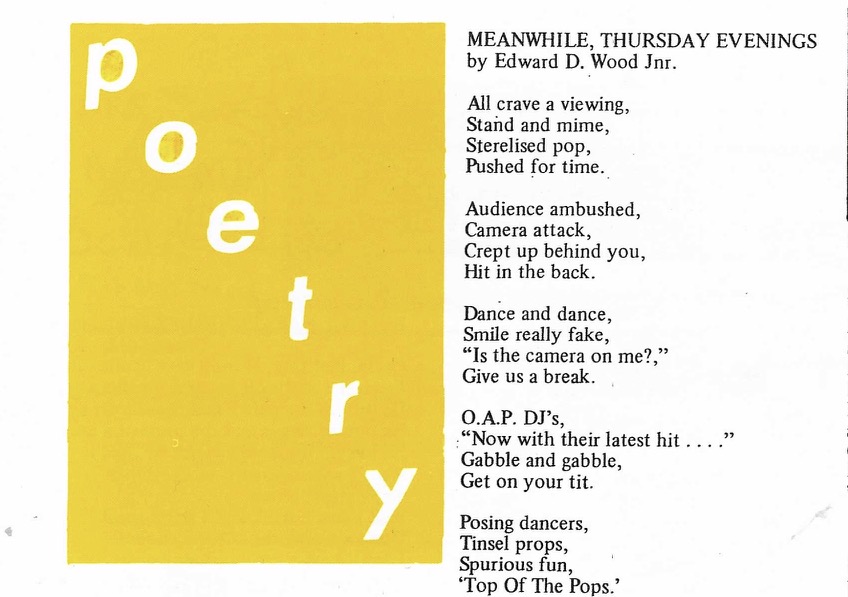
The fanzine was keen to do this to give people the chance to be creative even if they didn’t wish to be seen by their mates to be doing something like this. Editor Mick Potter tells the story about watching a Liverpool game standing on the Kop in the mid 80s. A fellow supporter shuffled up to him and inserted a piece of paper in his pocket with a word in his ear—“here’s a couple of poems, use them if you want to but don’t print my name.”
Properly Up North
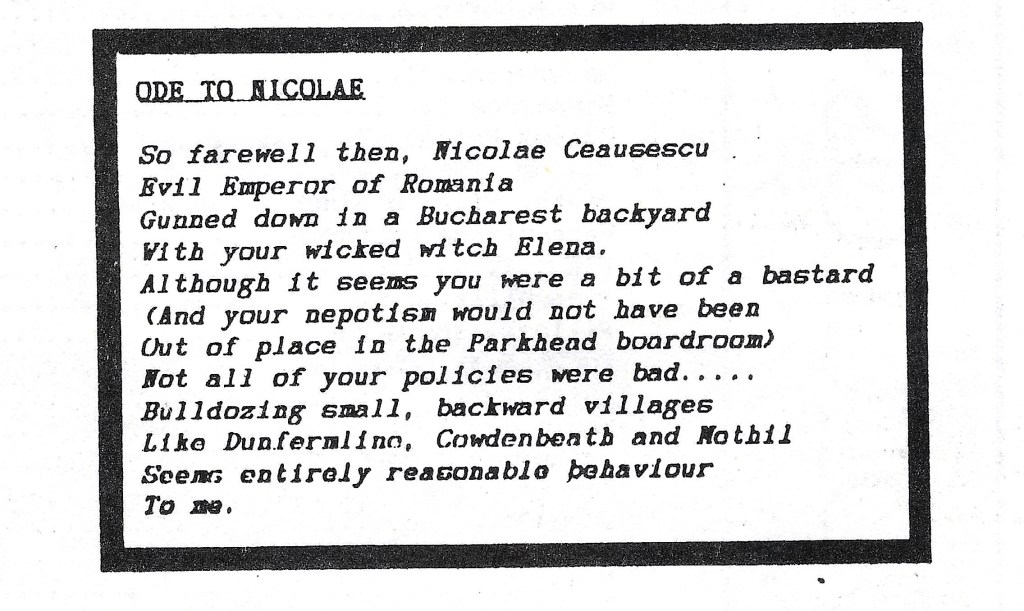
Perhaps less serious but still, it’s art from the Meadowbank Thistle fanzine AWOL issue 11 in 1989 an ode Nicolae Caeucescu who had recently been “relieved of his duties”. Why? Well, it allowed for jokes about rivals and insults about the old firm and outlying towns of Edinburgh. Exactly what you would expect from AWOL and any self-respecting fanzine.
Thistle had very poetic fans, this lovely ode to Meadowbank by David Stoker aged 12 at the time. This was the first of many great contributions he made to The Thistle and other Meadowbank fanzines. His lovely little verse manages to not only rhyme Armstrong and wrong but eulogises legendary keeper Jim McQueen (405 appearances over 13 years) but at the same time criticises the sweeper. Unbelievable Jeff.
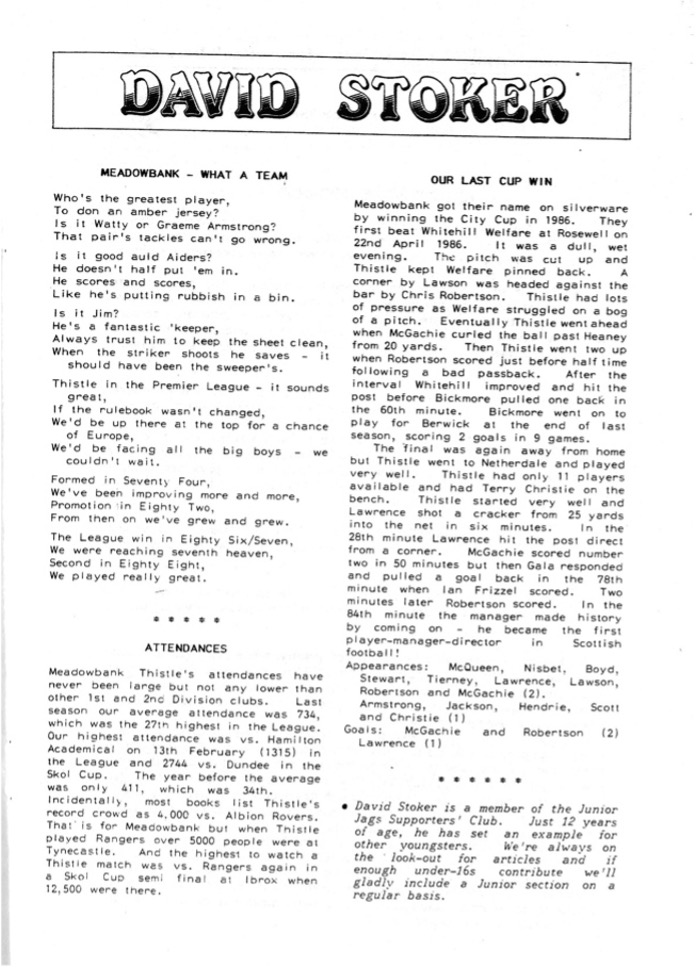
The attendances piece is enthralling, documenting an increase in average attendance from 411 to 734…a 78.6% increase. I need to find out more…
Ey Up, It’s a Poem
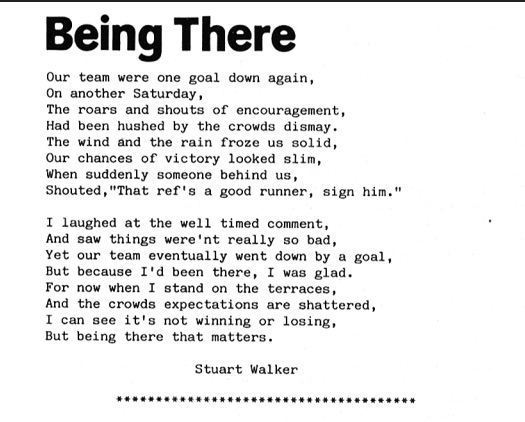
South Riding, a publication that many consider to have been Barnsley’s best had poetry right from the start. Issue 1 of the fanzine had this rather lovely little ditty in honour of watching the Tykes, crowd humour and stoicism in defeat. The poetry of football!
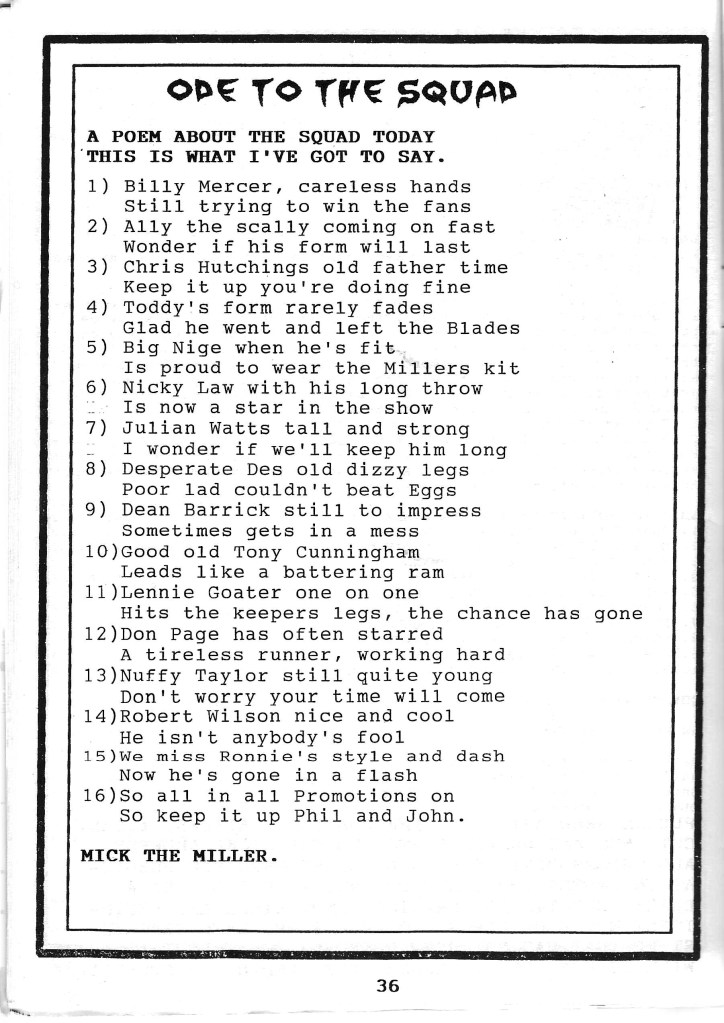
It didn’t have to be about matches past or protest, Rotherham’s Mi Whippet’s Dead issue 11 carried this lovely ode to the entire first team squad for the 1991-92 season. “Lennie Goater one on one, Hits the keeper’s legs, the chance is gone” and “Nicky Law with his long throw, Is now a star in the show” are tremendous.
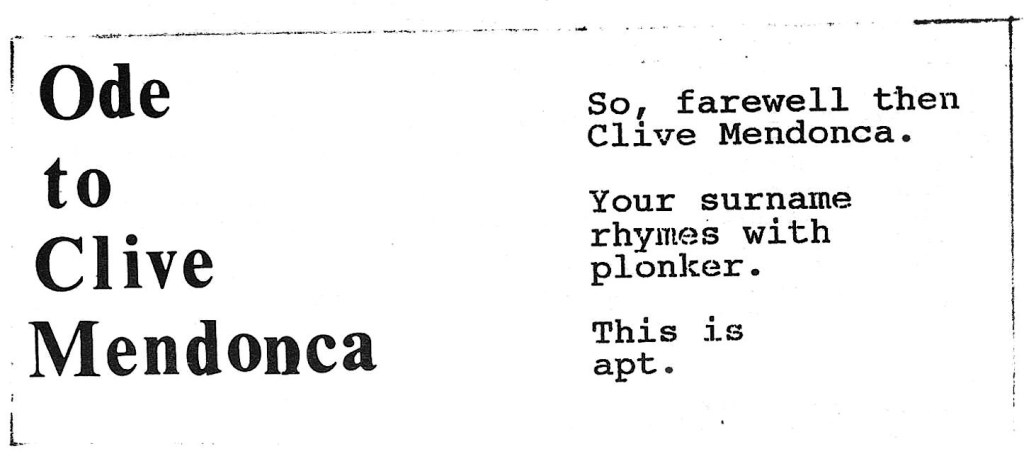
There must be something in the water in the River Rother or Don because another Rotherham classic Windy and Dusty also carried poetry though in this case, Volume 1 Issue 5 from 1991 carried a much shorter piece being rather less generous to a departing hero who had decided to move back down the road to local rivals Sheffield United.
Across the city A View From the East Bank, a tremendous Sheffield Wednesday fanzine, carried on that hatred of the Blades when they ran this poem called “The Moaning Cockney” all about a Wednesday fan’s “love” of Sheffield United manager Dave Basset.
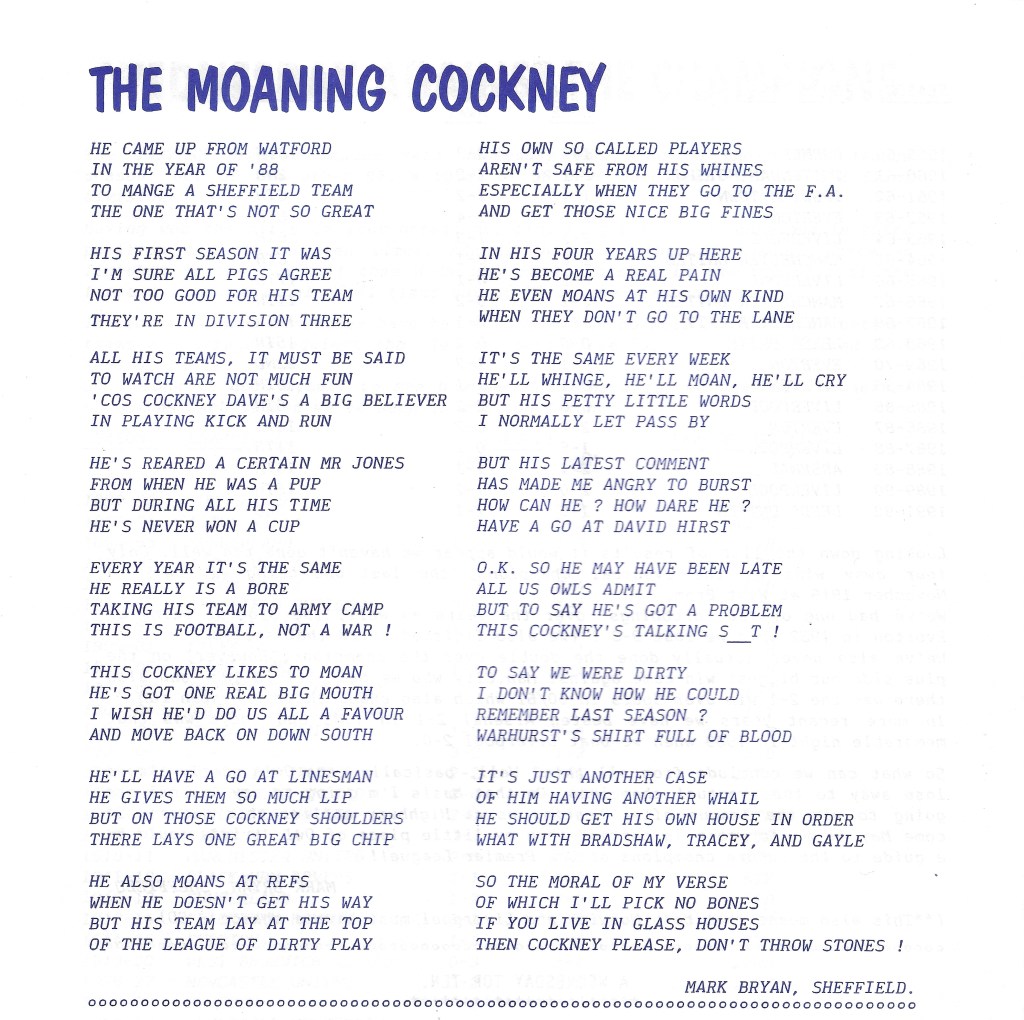
This must have taken some time to compose and is really quite clever and beautiful, demonstrating the passion but also the irrational nature of football supporting. It came about because of criticism of David Hirst (who was going to replace Gary Lineker according to this Stoke fan https://footballfanzineculture.blog/2026/02/13/floodlightfriday-the-oatcake-stoke-city/ )
The turning point of a season was marked in the end of season bonanza issue of Huddersfield zine Those Were The Days in 2001. It carried “An ode to not buying Peter Ndlovu”. Ndlovu had played 6 games for the Terriers on loan in 2001 scoring 4 times in 6 games including 2 on his debut which prompted Town’s longest unbeaten run of the season.
So why was this “specially prepared for Trevor Francis”? At the time Tricky Trev’ was the manager of Birmingham, Ndlovu’s home club who, upon seeing their man hit some form, recalled him. Back in Brum’ he helped them beat Ipswich Town in the semi-final of the 2000-01 League Cup.. but was then released before the final to join Sheffield United as Huddersfield were relegated on the last day of the season. Terriers fans were not impressed and this somewhat confusing tale about players being used as donkeys on a training trip to Blackpool appeared with the final stanza hoping Trevor gets the sack..
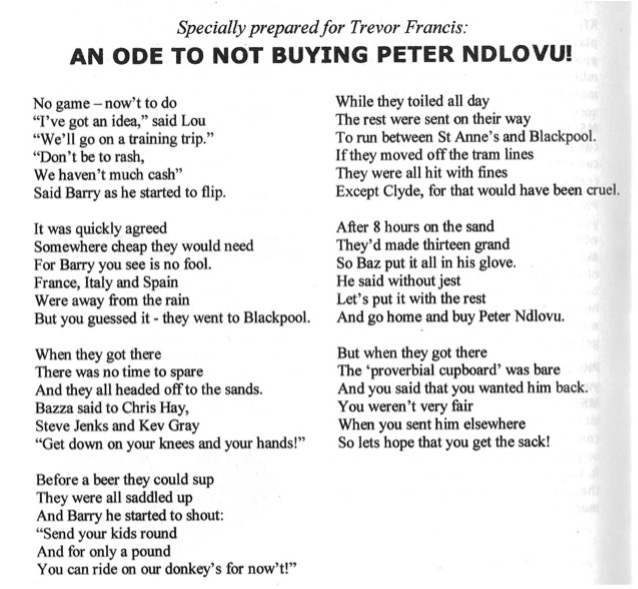
Lou Macari (who was known as a hard task master when it came to player fitness) had started the season as assistant to Steve Bruce but was promoted when Bruce once again failed and was sacked.
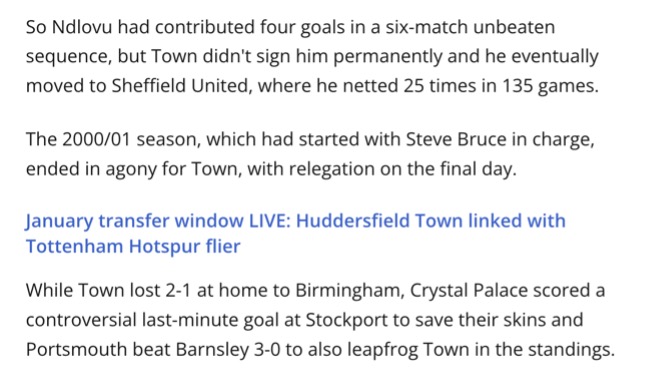
Whilst researching this little ditty I came across a summary of the season in the Huddersfield Examiner including Steve Bruce, hope and agony so in the spirit of fanzines decided to turn part of it into another terrible poem in the form of free verse, a tragedy from start to finish (The poem and the story). My sincere apologies.
Ode to Steve Bruce
“The 2000/01 season,
which had started with Steve Bruce in charge,
ended in agony for Town,
with relegation on the final day.”
Dahn Sarf
There seems to be a lot of Northern creativity on display here but fear not, we now move down to England’s capital and 1991 with a poem from issue 2 of Carlton, Carlton a Wimbledon fanzine. Here we can bask in the glory of… a Derby supporter presenting his children’s efforts about scoring a goal in Crap Poetry Corner.
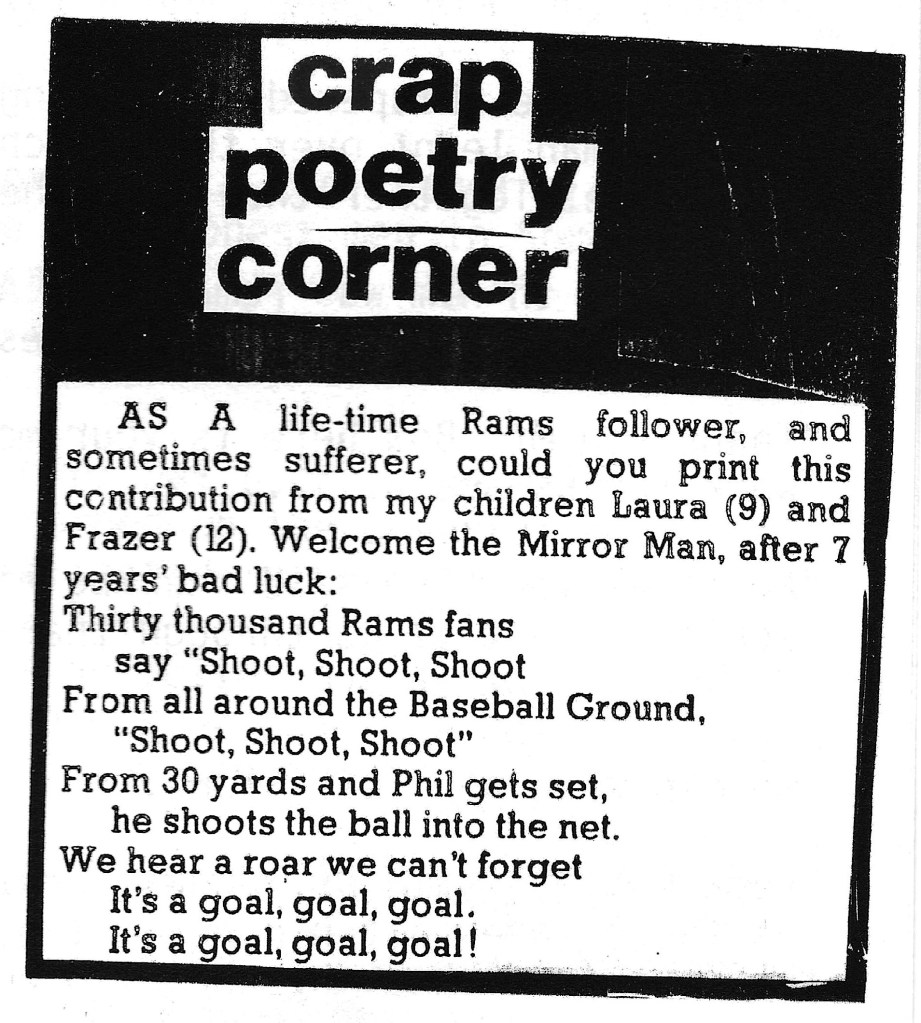
I have no clue why this is there. It appears in a travel guide to various grounds that is otherwise your regular, crap view, terrible food sort of thing. The other thing is that the bit about there being 30,000 at the Baseball ground in the 90’s does lead you to think that Laura and Fraser were perhaps not the actual authors of this. Fanzines eh?
West Ham fans fought against the proposed bond scheme at Upton Park in many ways. Boycotts, protest, in writing and in song at the ground so it should come as no surprise that creativity also reared its head in the form of a poem. Ode to West Ham, maligning the Bond Scheme appeared in On a Mission From God in August 1992.
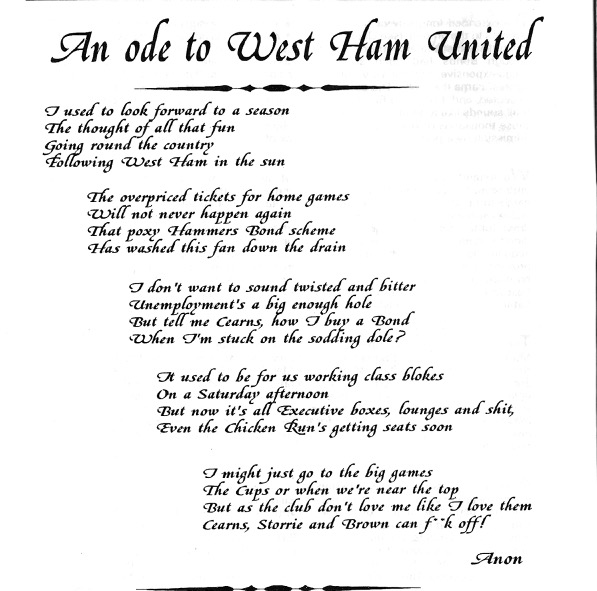
It’s a great piece of social history, the joy of watching home and away, the chicken run, unemployment and the dole and “executive boxes, lounges and shit” all mentioned long before Roy Keane uttered a soundbite about prawn sandwiches. Imagine if Roy had burst into verse instead. Now THAT I would like to see.
Final Whistle
I’ve always remembered this old American tongue twister from a 1902 musical called The Runaways.
“How much wood could a woodchuck chuck
If a woodchuck could chuck wood?
As much wood as a woodchuck could chuck,
If a woodchuck could chuck wood.”
Is it poetry? Well, it rhymes and it has a traditional structure and is way better than my Ode to Steve Bruce, so yes. It has had something of a resurgence recently as people with too much time on their hands ask wildlife experts or AI to calculate and answer, but that is missing the point.
Poems in fanzines might not be the most traditional or revered form of poetry but it encompasses all of the same devices, imagery and symbolism. More importantly it documents for us at a distance of decades the creativity, the social history and the voice and thoughts of fans. There are literally tens of thousands of poems in football fanzines, a rich vein that we will return to, next time I promise you a poem about an away day at Mansfield. In many ways poetry was the peak form of creativity in fanzines, however small or manic the thought, it is and was beautiful, expressive and informative, the very essence of self-publishing.

 Football Fanzine Culture
Leave a comment