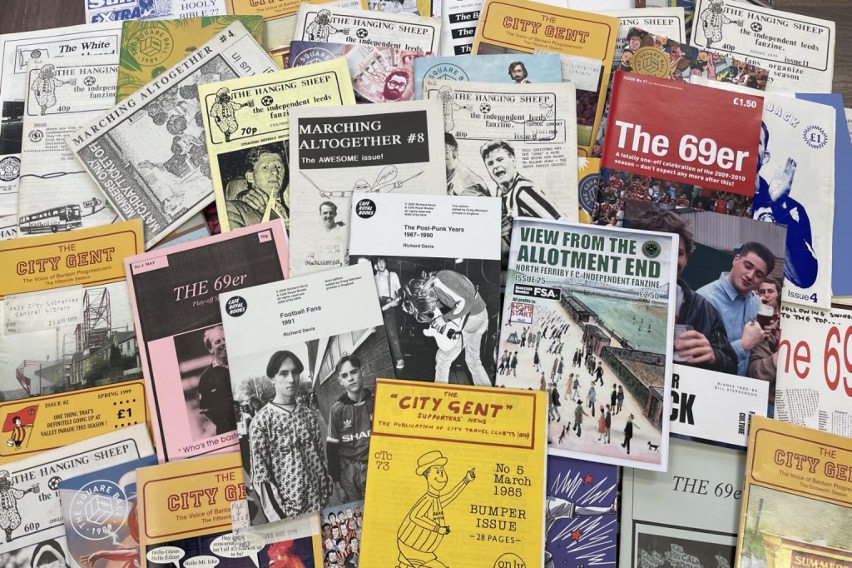
One of the best things about researching football fanzines is that you discover very niche but tremendous connections. How about one between a Nutmeg contributor and award-winning Scottish author and one of the biggest pop artists of the past 25 years? Well, both Neil Forsyth and Pete Doherty have suffered the wrath of parents over the use of naughty words in football fanzines.
In Nutmeg issue 4 Forsyth wrote about a piece in Falkirk Arabs“Disaster struck when my Mum read one of my pieces, a profane-laden assault on Dundee FC: “What is this?…” After emotional negotiations I was given a one-issue ban and forced to cancel my much-anticipated attendance at a school disco”
A terrible fate for sure but for Pete Doherty an even worse fate awaited. Doherty was responsible for a short lived but well respected QPR fanzine All Quiet on the Western Avenue. QPR were due to play in Liverpool where Doherty’s grandmother lived so he arranged for the fanzines to be delivered there but when his grandmother opened a copy of AQOTWA before his arrival, she did not like the ‘vernacular’ she discovered and ordered him to tip ex all the naughty words out before he could go out and sell it at Anfield. You can read more about it here https://footballfanzineculture.blog/2025/08/14/when-will-i-will-i-be-famous-a-side/
Let’s explore some more mishaps specifically from the history of Scottish publishing because I was sorting my crate of Scottish fanzines this week .
Foul Challenge
Fanzines often found themselves in hot water for “over exuberant” literary tackles (though calling the chairman a greedy prick in print probably does cross the line) and being banned from sale inside the ground was a common occurrence, sometimes without a word being read.

Meadowbank Thistle fanzines made an art of this. Take the cover of issue 12 of Thistle fanzine Cheers from February 1980, way before the explosion of fanzines in the late 80s. By 1985 there had still only been 8 fanzines in Scotland by our estimates in 1995 there were over 150 for comparison)
The Club banned Cheers because they said it was affecting programme sales, Cheers put it like this on the cover. ‘Prisoner at the bar, you are charged that, in the month of February, 1980, you did wilfully purchase issue 12 of Cheers magazine and that you did peruse therein a full sixteen pages of news and views…You stand accused of unlawfully failing to purchase an official match-pogrom’
Edited by a disgruntled former club programme editor, Alastair Petrie-Hay, Cheers only started calling itself a fanzine after issue 12 and by now was selling more copies than the official programme! We’ll come back to escapades at Meadowbank Thistle later with another fanzine, AWOL.
Skip forward nearly a decade and you see the pattern repeating. Hibs fanzine, The Proclaimer issue 8 from 1989 reported even worse tactics from the club with stewards not only confiscating copies of the fanzine but asking the police to get involved for some unknown reason. Even more remarkable that you’d think this would be headline news but no, it appears midway through the fanzine on page 9 as though it was just normal, part of the way fans and fanzines were treated at the time. (FYI, it was)

It’s In The Paper, It Must Be True
Celtic fanzine Not The View (NTV) tells the story of the day they hit the headlines in the tabloids. With Celtic due to face Airdrie in the 1995 Scottish Cup Final, former ‘Gers star and Airdrie manager Alex McDonald realised that NTV had run summaries of the Airdrie players that were less than flattering, news that was carried in the Mail.

Unflattering stuff for sure but no more than you would expect from a fanzine; Kenny Black apparently “Once sat as the model for City Bakeries hallowe’en cakes”, Luganis will “end up on his back more often than Pamela Bordes”. McDonald decided to take action and pregame took a copy of the fanzine into the dressing room to try and “fan the flames of passion” in his players stating “If the players can’t take anything out of it they must be dead from the toes up,”
Airdrie went on to lose the final 1-0 to a headed goal by Pierre van Hooijdonk and I think it’s more likely that their demise was partly because the players were still laughing at the description of McDonald “If it was left to people like McDonald then football would consist of several hundred young men trying to boot a severed head from one village to the next.”
FIGHT!

Back in Edinburgh in 1989, the cover of Hearts fanzine Gorgie Wave proudly boasts that it is “Banned From Stadium” as a banner on the cover and the story is expanded on inside in the editorial.
No Idle Talk, another Hearts’ fanzine seemed to take umbrage about Gorgie using this banner as ALL fanzines were now banned from Tynecastle and they wanted the credit.

Rows between fanzines of the same team weren’t unusual either and the editor quite rightly points out the need to focus on the chairman, the real source of problems and even gives No Idle Talk a good review later in this edition.
But this being fanzines this led to “an hilarious year-long episode of letter writing (no email back then) and public exchange via the two zines with claim and counter-claim including a letter which another Hearts fanzine Dead Ball printed in full.”Ah the days of frantic letter writing, circulars and fanzines squabbles…heady stuff and we believe Gorgie Wave only ran for 7 issues, so this feud lasted for most of its life.
Chairman Wallace Mercer’s comment that “we obtain no financial gain” from fanzines pretty much sums up all you needed and indeed need to know about chairmen, CEOs or owners of clubs since the beginning of time about fans. In the 90s clubs up and down the land often used the excuse that a fanzine was taking away revenue from the club. The common reply to this was quite rightly that the programme should be better.
Issue 3 of Gorgie Wave reveals another and this time actual “Legal” issue on the letters page, one that besets fanzine editors to this day. I doubt when you start a fanzine the ins and outs of the Scottish Copyright Act, 1911, Section 15 is something foremost in your mind but there you go.

The NLS addressing the letter to the wrong fanzine didn’t help but Gorgie’s reply is a classic of the kind “That’s one way to get a free subscription”. I can report that issue 3, 4 & 6 of GW do appear in NLS despite the tone of and reply to this legal request. I’m glad Mr Wellburn was so serious about his job as it’s made my research easier and indeed even possible in some cases. Many fanzine editors are still unaware of this arcane act but to this day they are required to supply a copy to the NLS and up to 5 more copies of every publication to any libraries that ask.
Cartoonish
Rupert’s Roar (RR) was a Falkirk fanzine that started in 1992, it contained a cartoon strip and character called “Rupert the Bairn” for the first few issues, but the feature was scrapped due to threatened legal action by the Daily Express newspaper. Thankfully RR survived and went on to gather a circulation of around 1500 before its print demise in 1996, although it was still around until 2000 in the internet as Web Roar.

OK, the Daily Express had run an item with Rupert the Bairn as a heading for an item that appeared in their newspaper in 1990 (The name was also registered as the name of a greyhound) but Rupert the Bairn didn’t start in Rupert’s Roar, it had already been appearing since 1988 in The Falkirk Unofficial fanzine (FUF)

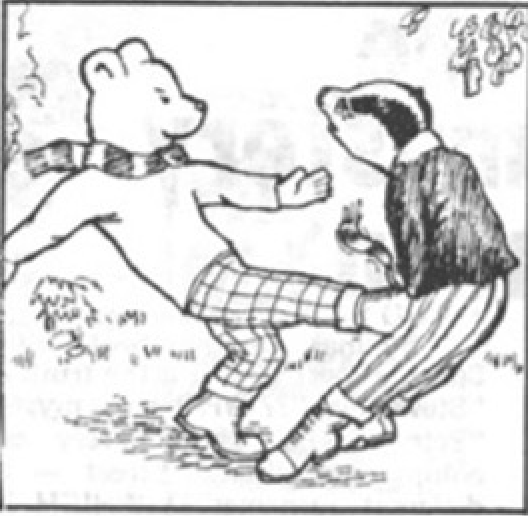
Express newspapers clearly weren’t that observant in the 70s either because this cartoon about Rupture and the Oaktree Skins had appeared in issue 11 of general football fanzine, Foul in 1973. You’d think they’d take far more umbrage at this cartoon of the remarkably similar Rupture the Bear’s hooligan behaviour than a couple of badly drawn pictures in FUF or RR.

This theme of “borrowing” famous cartoons for scurrilous reasons was of course common; how about Winnie The Scumbo from issue 21 of Hibs Monthly in 1989 (which even carries the Walt Disney company copyright logo) or a Calvin like character in the Hibs Kids cartoon strip from the same journal in issue 30 from 1990


Lists, Shopping or Otherwise
To finish though, let’s get back to our beloved Back to Meadowbank Thistle and the cheeky lads at AWOL, known for liking a bit of a jape. As a club Meadowbank’s punk credentials were formed in the late 1970s when John Jobson signed for the club, the striker being the brother of ‘The Skids’ front man Richard Jobson who was also reported to have been on their books. John Jobson would go on to play 137 times for Thistle, scoring 58 goals and became a real hero. No idea what happened to The Skids.
Carrying the punk connection further, the fanzine carries a top 10 chart in issue 6 but this wasn’t music based but rather “Stupid things to do when drunk” gives you some idea of their approach to fandom.

The fanzine came about from a group of supporters who had been helping with the programme but were censored when they suggested “armed robbery” at a supporters’ club committee meeting about fundraising. They formed from the Brake club, a breakaway fan group who were fed up with the boring old supporters’ club, a group of lads who wanted to go to games early so they could avail themselves of the facilities in local pubs both before and after the game. From this ethos came AWOL fanzine.
A quarterlyish football, music, humour and lifestyle zine that “leaked taste, politeness and decency and so is rarely boring” often gave away free 7″ singles by Edinburgh bands like “Call Girls and “Vatican Shotgun Scare” all of whom were on their own record label obviously. AWOL also organised a reading of The Satanic Verses on a bus to an away game at one point.
As mentioned last week, their shoplifters guide to Edinburgh was perhaps taking it a bit too far. Also appearing in issue 6 it is clearly marked as “A totally irresponsible article”, but they went ahead with it anyway.

I should add that this was not a joke, it was a real guide and is of course littered with musical allusions. Absolutely superb. Obviously it raised more than a few eyebrows and the local constabulary were rumoured to be interested. It wasn’t unusual with AWOL to be in trouble with the club but Colin McPherson of the fanzine told me “The Shoplifters Guide to Edinburgh got us into terrible bother with the club when we published that. Got hauled up in front of the chairman, a lovely old man called Squadron Leader John Blacklaw, a decorated WW2 spitfire pilot and war hero. No idea what the fuck he made of us.”
Being banned because someone at the club got huffy about something some fans said might seem ridiculous, but this sort of nonsense was common, trying to get the polis involved was pathetic but the sort of stunt fans faced in the 80s and 90s. Fanzines landed themselves in trouble with the law quite a few occasions, to be honest though it was a fraction of the number of times it could / should have been.
Last Orders
Why was this? Well, many fanzines came from the punk DIY ethos with little regard for accepted norms and I’ll also highlight perhaps the greatest fanzine “office” address of all time, Caledonian FC’s ‘On A Life Support Machine’ which gives another hint as to why this might have been.

I mean yes, being rude and copyright infringement however funny is a serious business but you can’t help feeling that a pamphlet that sold a few hundred copies and often raised funds for impoverished clubs being told to cease and desist seems very heavy handed, especially when you realise how many times the same thing was being missed.

Leave a Reply